 Hossainul Sazzad
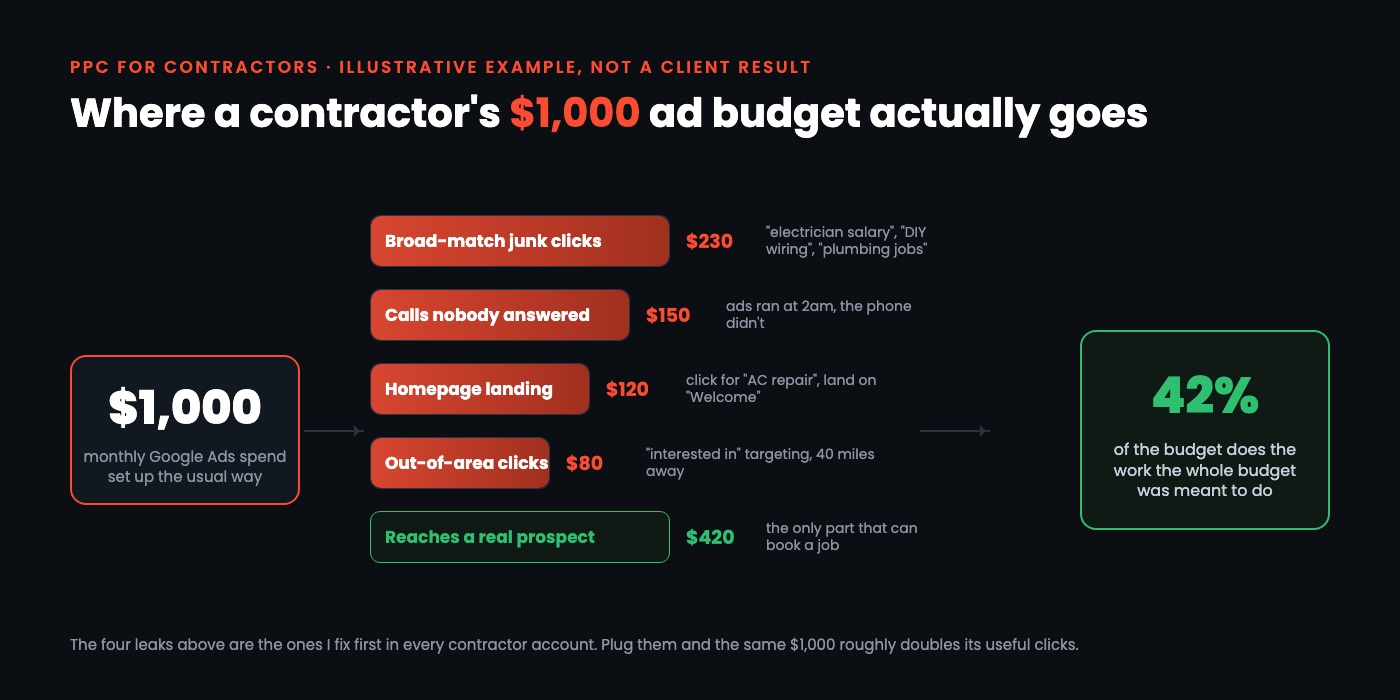
Contractor PPC is the most expensive kind of search advertising most small businesses ever run. LocaliQ's 2026 benchmarks put the Home & Home Improvement category at $8.33 per click and $90.92 per lead, with a 6.47% click-through rate and an 8.05% conversion rate. Those are averages across the whole category; emergency keywords in big metros run far higher.
At those prices, a leak that would be a rounding error in a $50,000 ecommerce account eats half of a $1,000 contractor budget. I run Google Ads for electricians, HVAC companies and plumbers, and every account I take over has the same four leaks. This guide is how to find them, plug them, and structure the account so they do not come back.
What PPC for contractors means in 2026
Pay-per-click for a contractor is really three products from Google, and the usual mistake is treating them as one:
- Search ads. Text ads above the organic results, charged per click, where you choose the keywords. This is the account the rest of this guide is about.
- Local Services Ads. The Google Guaranteed box at the very top of the page, charged per lead rather than per click, after Google has checked your licence and insurance. Google's getting-started guide lists the eligible trades. For emergency work it usually beats Search on cost per lead.
- Performance Max. Google's automated campaign type that spreads budget across Search, Maps, YouTube and Display. It works for a brand with conversion data to learn from; for a contractor with twenty conversions a month it mostly buys cheap, useless clicks. I leave it off until Search produces at least 50 conversions a month.
The right order for a contractor is Local Services Ads first if the trade is eligible, Search second for the keywords LSAs do not cover (replacement, installation, anything with a quote attached), and Performance Max last, if ever. The first decision is covered in detail in Local Services Ads vs Google Ads.
Leak 1: broad match with no negative keywords
Google defaults new keywords to broad match, and its keyword matching documentation says plainly that broad match can show your ad for searches related to your keyword. For "electrician", related means "electrician salary", "how to become an electrician", "electrician jobs near me" and "DIY outlet wiring". Every one of those is a click you pay for from someone who will never hire you.
The fix has two steps. Run the money keywords on phrase and exact match, and load a negative keyword list before the campaign goes live, not after the first invoice. My starter list for every trade: salary, jobs, hiring, career, course, school, certification, training, DIY, how to, free, cheap, manual, parts, supply, wholesale, union, apprentice. Then read the search terms report every week and add to it. In the accounts I audit, this leak alone is typically 20 to 30 percent of spend.
Leak 2: ads that run when the phone does not
Emergency searches peak at night and at weekends. If nobody answers at 2am, every one of those clicks is a lead you paid for and then lost, usually to the competitor who did pick up. Either staff the phone (an answering service costs less than the wasted clicks) or schedule the campaign to the hours you actually answer. The one exception is a form-first trade like remodeling, where an overnight form fill is fine.
Set up call reporting so Google counts calls over 60 seconds as conversions, then check the call log against the ad schedule. Missed calls show up there plainly.
Leak 3: landing on the homepage
Someone who searched "AC repair near me" and lands on a page that says "Welcome to Smith Heating and Cooling, serving the community since 1987" is one tap from the back button. Each ad group needs its own landing page that repeats the search in the headline, shows the phone number and a tap-to-call button above the fold, lists reviews, and names the service area. Google's Quality Score rewards that relevance with cheaper clicks, so this leak costs twice: the bounced visitor, and a higher price on every click after.
Run your landing page through my free 30-second audit tool. A page that takes six seconds to load on mobile loses the visitor before the headline renders.
Leak 4: paying for clicks outside your service area
Google's default location setting includes people who have shown interest in your area, which for a contractor means a homeowner in another state researching a vacation property, or someone who once searched your city. Switch it to presence only, draw the radius around where your trucks actually go, and exclude the neighbouring metro you do not serve. Then layer bid adjustments: up in the zip codes where your best jobs come from, down where the drive time kills the margin.
Want to know where your ad budget is leaking?
Send me read-only access to the account, or just your website and city. I will check the four leaks, your real cost per lead against the benchmark, and send the fixes in priority order. Free, within 24 hours, no call required.
Get My Free Google Ads ReviewThe account structure that stops the leaks coming back
Once the leaks are plugged, the structure is what keeps them plugged. The version I build for every trade:
- One campaign per job type and urgency. Emergency repair, scheduled service, replacement and installation. They need different budgets, schedules and landing pages, so they cannot share a campaign.
- Tight ad groups. Five to fifteen closely related keywords each, phrase and exact match, with responsive search ads whose headlines repeat the keyword.
- A budget split that moves with the season. Roughly 50 percent emergency, 35 percent replacement, 15 percent maintenance for a single-location company. The HVAC version is drawn out in my HVAC Google Ads structure.
- Conversions that mean money. Calls over 60 seconds and quote forms. Not page views, not "contact page visited". Smart Bidding optimises toward whatever you call a conversion; call the wrong thing a conversion and it will find you more of it.
- A weekly 30-minute routine. Search terms report, new negatives, call log against schedule, budget pacing. Accounts rot without it.
A Search account I run on exactly this structure has produced 98.3K clicks and 15.8K conversions; the dashboard is on my Google Ads for contractors page.
What contractor PPC costs, and what a lead should cost
Two numbers matter. The media budget goes to Google: for a single-location contractor, $1,000 to $3,000 a month is the range where the account gathers enough data to be optimised, and below about $500 the clicks are too few to learn from. The management fee goes to whoever runs it: a flat fee, a percentage of spend, or a hybrid. The three models, and who should not buy management at all, are set out on my Google Ads management services page. The short version is that under roughly $1,000 a month of spend, paid management rarely pays for itself.
For cost per lead, the LocaliQ benchmark of $90.92 is the category average. A plugged account in a mid-sized metro should beat it for maintenance and repair work and may run above it for replacement leads, which are worth ten times as much. Judge the account on cost per booked job, not cost per click, and compare it with what the same job costs from local SEO, which takes months to build but does not stop when the budget does.
Where this fits
PPC is the fastest channel a contractor has and the only one that switches off the day you stop paying. It works best alongside the compounding channels: Local Services Ads for emergency demand, local SEO for the Map Pack, and Meta Ads for the planned, high-ticket work nobody searches for until they are ready. How the channels compare on cost is in electrician marketing, and the paid-search versus paid-social question is answered in Google Ads vs Meta Ads for home services. If you would rather have the account built and run for you, that is Google Ads for contractors.
Frequently Asked Questions
What is PPC for contractors?
Pay-per-click advertising where a contractor pays Google each time someone clicks an ad for a search like "emergency electrician near me" or "AC replacement cost". It covers three Google products: Search ads (pay per click, you choose the keywords), Local Services Ads (pay per lead, Google verifies your licence and insurance first) and Performance Max (automated). For most contractors the right order is Local Services Ads first, Search second, and Performance Max only once Search is producing 50 or more conversions a month.
How much does PPC cost for contractors?
LocaliQ's 2026 search benchmarks put the Home & Home Improvement category at $8.33 per click and $90.92 per lead, and emergency keywords in large metros cost more than that. In practice a single-location contractor needs $1,000 to $3,000 a month of media budget for the account to gather enough data to be optimised; below about $500 a month there are too few clicks to learn from. Management, if outsourced, is on top of that.
Is Google Ads worth it for contractors?
Yes, when the four leaks are plugged (broad match without negatives, ads running when nobody answers, homepage landing pages, out-of-area clicks) and the account is judged on cost per booked job rather than clicks. It is not worth it under roughly $500 a month, or for a company that cannot answer the phone during the hours the ads run.
What is a good cost per lead for contractors?
The 2026 category benchmark is about $91 per lead. A well-run account in a mid-sized metro should beat that on repair and maintenance work and may pay more than that for replacement and installation leads, which are worth ten times as much. The number to manage is cost per booked job, which needs call tracking and a weekly look at which calls became jobs.
Should contractors use Local Services Ads or Google Ads?
Both, in that order. Local Services Ads cover emergency and standard jobs at a cost per lead with the Google Guaranteed badge, and they usually beat Search on cost per lead for that work. Search ads cover what LSAs do not: replacement, installation and anything with a quote attached, where the buyer researches before calling.
What does PPC management for contractors cost?
Three models: a flat monthly fee, a percentage of spend (typically 10 to 20 percent), or a hybrid. Below roughly $1,000 a month in media spend, paid management rarely pays for itself, and the better move is to learn the weekly 30-minute routine yourself. Any contractor PPC agency worth hiring reports call-tracked cost per booked job, not clicks.
Want the leak check before you decide anything?
Tell me your trade, city and roughly what you spend. You will get the four leaks checked against your account, your cost per lead against the benchmark, and the fixes in priority order. If the honest answer is that you should not be running ads yet, that is what I will tell you.
Get My Free Review
Local SEO & Paid Ads specialist for home service businesses in the US, UK and Canada. Google-certified, and behind results like 359K organic clicks for a UK retailer and a Texas electrical company's organic traffic doubling in six months.