 Hossainul Sazzad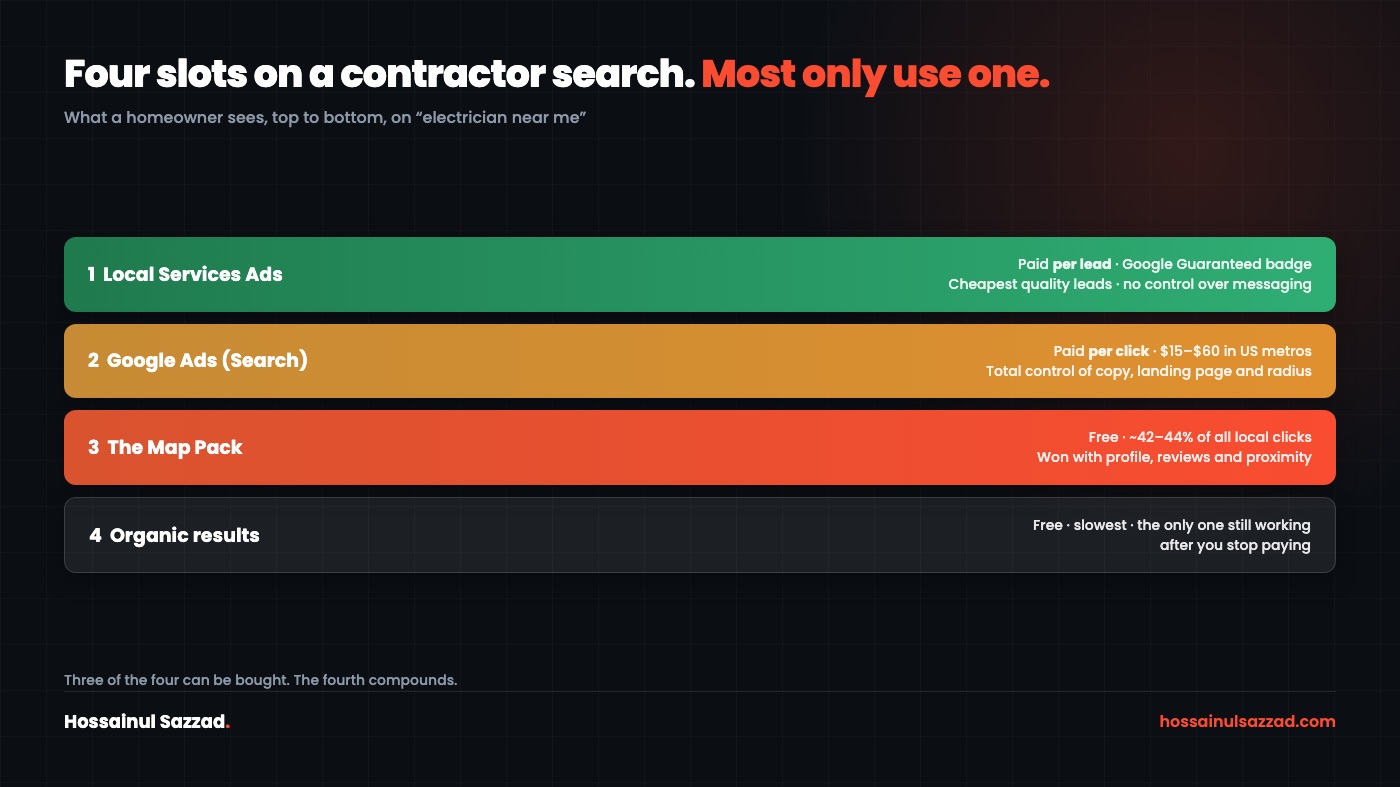
Every contractor I onboard asks some version of the same question in the first call: should I be running Local Services Ads, Google Ads, or both?
The honest answer is "both, in a specific order", but that's useless without knowing why, so here's the actual comparison, including the parts Google's own documentation is vague about.
The one-paragraph version
Local Services Ads sit above everything on the page, carry the Google Guaranteed badge, and charge per lead. Google Ads sits below LSAs and above the map, charges per click, and lets you control every word and every service. LSAs are usually cheaper per lead and much more limited. Search Ads cost more and do far more. Most contractors should start with LSAs and add Search for the work LSAs can't reach.
Where each one sits on the page
Search "electrician near me" on a phone and you get, top to bottom: Local Services Ads, then Google Ads, then the Map Pack, then organic results. Three of those four are things you can pay for, and the fourth is what my 21-step electrician SEO guide covers.
Position matters enormously here because the Map Pack alone takes roughly 42–44% of local search clicks, and LSAs sit above it.
Local Services Ads: what you're actually buying
You pay per lead, not per click. A call or message that meets Google's criteria costs you money; someone clicking and bouncing does not. For most trades this makes the effective cost per lead lower than Search.
The Google Guaranteed badge does real work. Passing the background and licence checks earns a green badge and Google's backing of the job up to a coverage limit. Homeowners notice it.
You can dispute bad leads. Wrong number, out of area, someone asking about a service you don't offer, dispute it and get refunded. Most contractors never bother, and it's free money.
What you give up:
- No control over messaging. Your listing is your business name, reviews, badge and hours. No headlines, no offers, no landing page.
- Category and area limits. Coverage is good for electricians, plumbers, HVAC, roofers and garage door, and patchy or absent for others. Paving, asphalt and masonry contractors usually have to qualify under general contracting, and it varies by city, check the category list for your ZIP before assuming.
- Ranking factors you influence indirectly. Review score, review count, responsiveness, proximity and how fast you answer. You can't bid your way past a competitor with better reviews and faster response times.
Google Ads Search: what you're actually buying
Control over everything. Which searches you appear for, what the ad says, where the click lands, what radius, what hours, what devices. You can bid only on panel upgrades and generator installs and ignore $90 outlet swaps entirely.
Reach beyond LSA categories. Every service you offer, including specialty work LSAs don't have a category for.
What it costs you:
- Clicks in the trades are expensive: commonly $15–$60 in competitive US metros, higher for emergency terms. You pay whether or not the visitor calls.
- Build quality decides profitability. A campaign at a 3% conversion rate and one at 12% spend identically and produce four times the difference in leads. Negatives, tight ad groups, landing pages and call tracking are the whole game.
Side by side
- You pay for: LSA, qualified leads. Search, clicks.
- Position: LSA, very top. Search, below LSA, above the map.
- Control: LSA, almost none. Search, total.
- Setup effort: LSA, verification paperwork, then simple. Search, ongoing management, permanently.
- Speed to first lead: LSA, days after verification clears. Search, same day.
- Best for: LSA, emergency and routine service demand. Search, high-ticket, specialty and anything outside LSA categories.
- Refunds available: LSA, yes, disputable. Search, no.
If you'd rather hand the account over than run it yourself, here's how I handle Google Ads management, including what it costs.
Not sure which one your budget should go into first?
Tell me your trade, your city and roughly what a job is worth. I'll tell you which to run first and what to expect per lead, and if the honest answer is "neither yet, fix your Google Business Profile", I'll say that instead.
Ask Me Which to Run FirstThe order I'd actually run them
- Google Business Profile first, always. It's free, it feeds the Map Pack, and your LSA ranking depends partly on the same review signals. Running paid over a broken profile is paying to cover a hole. Start with my 42-point GBP checklist.
- Local Services Ads second, if your category and city are covered. Cheapest quality leads, least ongoing management. Start verification early. It takes weeks.
- Google Ads Search third, targeted narrowly at high-ticket and specialty jobs LSAs can't reach. Don't mirror your LSA coverage; complement it. That's what my Google Ads management for contractors covers.
- Local SEO underneath all of it. Slowest, and the only one still producing when you stop paying.
The mistake that costs the most
Running Search ads on the exact same emergency keywords your LSAs already cover. You end up paying twice to reach one homeowner, once per lead and once per click, competing with yourself for a customer you'd have won anyway.
Split the demand instead: LSAs take "electrician near me" and emergency work. Search takes "electrical panel upgrade cost [city]", "EV charger installation", "whole home generator install", the high-ticket, considered purchases where a landing page and a real price range do the convincing.
If you want the wider platform comparison including paid social, I covered that in Google Ads vs Meta Ads for home services.
Frequently Asked Questions
Are Local Services Ads cheaper than Google Ads?
Usually per lead, yes, because you pay only for qualified contacts rather than every click. For routine service demand LSAs typically produce a lower cost per lead than Search. But they only cover certain categories and areas, so the comparison only holds where LSAs are available to you at all.
Do Local Services Ads show above Google Ads?
Yes. On local service searches the order from the top is Local Services Ads, then Google Ads, then the Map Pack, then organic results. That top position combined with the Google Guaranteed badge is the main reason LSAs convert well.
Can I run Local Services Ads and Google Ads at the same time?
Yes, and most contractors should, but split the demand rather than duplicating it. Let LSAs take emergency and routine service searches, and point Search campaigns at high-ticket and specialty work LSAs have no category for. Bidding Search on keywords your LSAs already cover means paying twice for the same homeowner.
How do I rank higher in Local Services Ads?
Review score and review count, how quickly you respond to leads, your proximity to the searcher, your responsiveness rate, and whether your Google Guaranteed verification is current. Unlike Search, you cannot simply bid your way to the top past a competitor with better reviews and faster response times.
Can you get a refund for bad Local Services Ads leads?
Yes. Leads that are out of your service area, for services you do not offer, spam, or wrong numbers can be disputed through the LSA dashboard and credited back. Most contractors never do this, and over a year it adds up to real money.
Which trades are eligible for Local Services Ads?
Coverage is solid for electricians, plumbers, HVAC, roofers, garage door, locksmiths, landscaping, house cleaning and general contracting. It is patchy or absent for others, paving, asphalt and masonry contractors usually have to qualify under general contracting, and availability varies city by city. Check the category list for your ZIP inside the signup flow before planning a budget around it.

SEO & Paid Ads specialist working with B2B SaaS and home service businesses in the US, UK and Canada. Google-certified, and behind results including 359K organic clicks in 12 months for a UK client and a Texas company's organic traffic doubling in six months.