 Hossainul Sazzad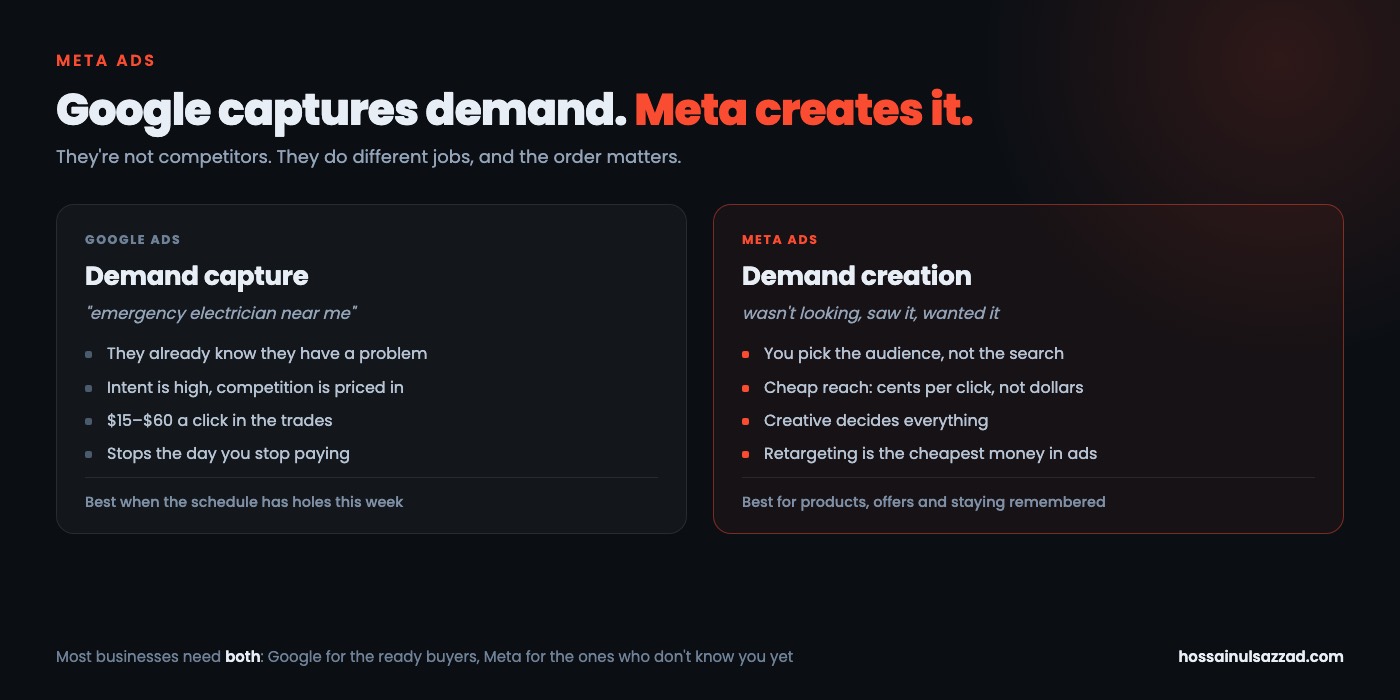
The most common mistake I see with Meta Ads is treating it like Google Ads with different buttons.
On Google, somebody types "emergency electrician near me" and you bid to be there. The intent already exists; you're paying to capture it. On Meta, nobody is looking for you. You're interrupting a scroll, which means the creative does almost all of the work: the targeting options everyone obsesses over matter far less than what the ad actually shows.
That single difference decides how the account should be built, how much you should expect to spend before it works, and whether Meta is even the right platform for you this quarter.
What my Meta ads services include
- Account and campaign structure. Separate campaigns by objective and audience temperature: cold prospecting, warm engagement and retargeting should never share a budget, because they don't share a job.
- Pixel and Conversions API setup. Server-side events alongside the browser pixel, with proper deduplication. This is the fix for the iOS tracking gap, and it's missing from most underperforming accounts I look at, which means Meta's algorithm has been learning from partial data the whole time.
- Creative direction and testing. Angles, hooks and formats, briefed so your photos and video get used properly. Creative fatigue is the main reason a good Meta account decays, so this is ongoing work, not a one-off.
- Audience testing that ends. Broad versus interest versus lookalike, tested to a decision rather than tinkered with forever.
- Catalogue and dynamic product ads for ecommerce, Shopify feed setup, product sets, and dynamic retargeting for people who viewed or abandoned.
- Retargeting, sensibly. Short windows, capped frequency. Consistently the cheapest conversions in any account, and the easiest to make annoying.
- Reporting against revenue or booked jobs: not reach, not engagement, not "impressions up 40%".
Real campaign data
A Meta account I run, straight from Ads Manager, the two weeks of 22 April to 5 May 2025:
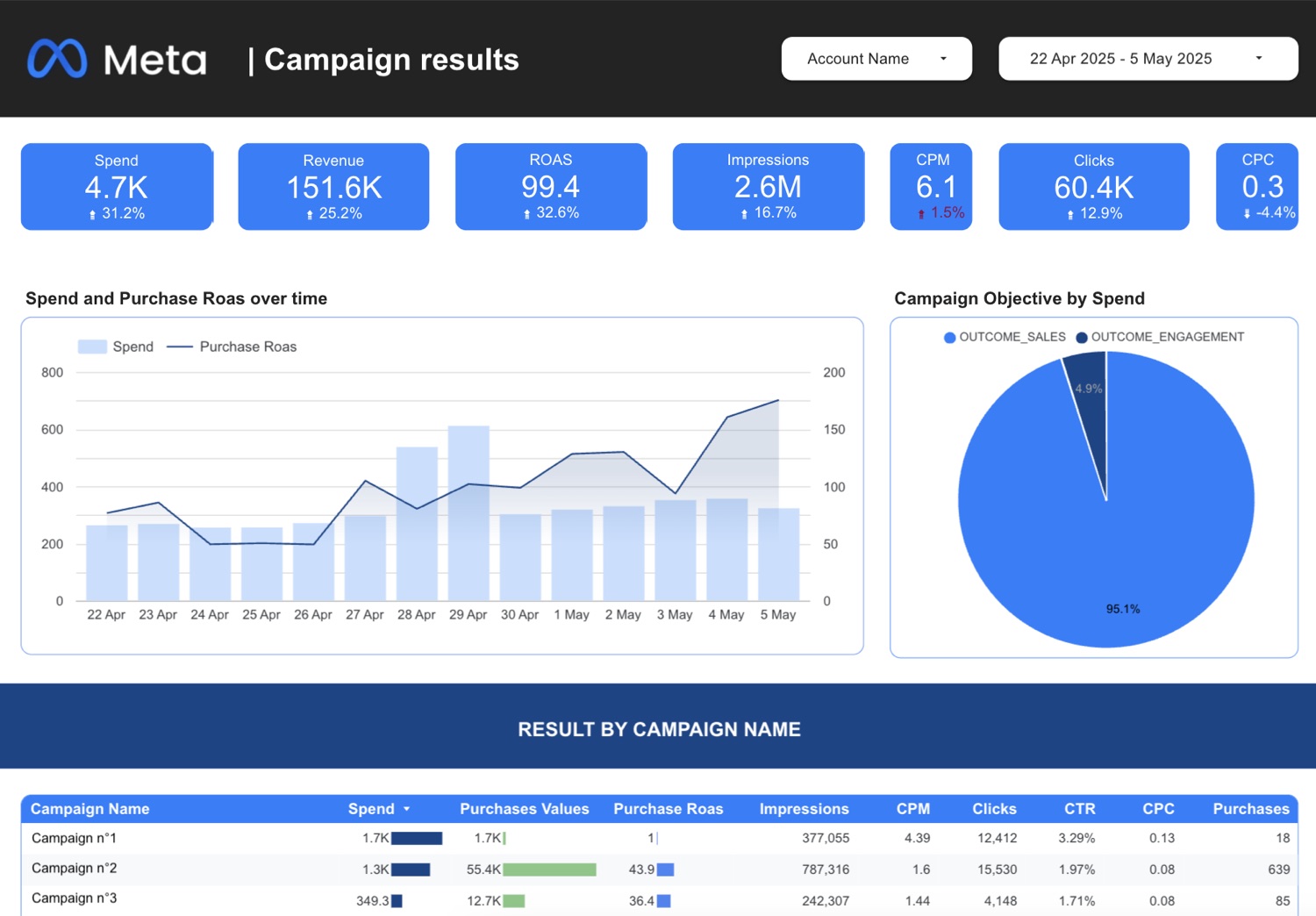
Now the honest reading of that screenshot, because a 99x return is not a normal number and I'd rather explain it than let it do the selling:
- It's a two-week window on a product with unusually strong margins and a low price point. Pick a different fortnight and it looks different.
- Most of the revenue comes from one of three campaigns: you can see campaign 2 carrying it in the breakdown. That's normal, and it's why killing losers fast matters more than optimising winners.
- ROAS is reported on Meta's attribution, which is generous to Meta. I always cross-check against actual store revenue before treating it as truth.
- Do not expect this. Your break-even ROAS is 1 divided by your gross margin. For most businesses a 3–5x return is a genuinely good outcome.
I'd rather show you one real account with its caveats than five screenshots with none.
Want to know if Meta is even right for you?
Tell me what you sell and roughly what a customer is worth. I'll tell you honestly whether Meta Ads, Google Ads or neither is where I'd put the next dollar, and if your tracking is broken, I'll tell you that first, because nothing else matters until it's fixed.
Get My Free Meta Ads ReviewWho I run Meta Ads for
Two very different accounts, which is deliberate, the platform behaves differently for each:
- Hooked Up Electric (electrical contractor, Abilene, Texas, named with permission). Local service work, where Meta earns its place on planned jobs rather than emergencies, plus retargeting people who visited the site and didn't call.
- Cowpuncher Babe (Shopify apparel brand). Ecommerce, where catalogue ads, creative volume and dynamic retargeting do the heavy lifting and revenue is measurable to the dollar.
I also run the organic and paid search side for both, which matters more than it sounds: when the same person runs Meta, Google and SEO, the retargeting audiences and the landing pages actually line up instead of being three disconnected projects.
Facebook ads for contractors: where they actually work
Let me save some contractors money. Meta will not fill your emergency schedule. Nobody scrolls Instagram and decides their panel needs replacing this afternoon. That demand starts in search, which is what Google Ads for contractors is for.
Where Facebook ads for contractors genuinely earn their budget:
- Planned, high-ticket work: generator installs, EV chargers, panel upgrades, whole-home rewires. Considered purchases people research for weeks.
- Seasonal demand, ahead of the season: HVAC replacement advertised in spring, not during the first heatwave when everyone is bidding.
- Retargeting site visitors: the cheapest money in the whole account.
- Local brand presence: being the name people already recognise when they eventually do search.
If your problem is that the phone isn't ringing this week, Meta is the wrong tool and I'll say so. The full channel comparison is in Google Ads vs Meta Ads for home services.
What Facebook ads management services cost
Two separate numbers, as always. Ad spend goes to Meta; management goes to whoever runs it.
- Management: 10–20% of spend, or a flat $500–$1,500 a month for a single account. Flat is usually the better deal below about $5,000 in spend, and it doesn't reward your manager for spending more of your money.
- Ad spend: from around $1,000–$3,000 a month for a local service business, and higher for ecommerce, where Meta needs roughly 50 conversion events per ad set per week to exit the learning phase.
- Creative is the cost people forget. If you can't supply photos and video regularly, budget for producing them, on Meta that's not optional.
Below about $600 a month in ad spend, a managed Meta account rarely gathers enough data to leave the learning phase, and the fee eats the budget. I'd rather tell you that now than take the retainer.
Agency or one specialist
The honest tradeoff, and Meta is the one channel where the case for an agency is strongest:
- An agency gives you creative production volume. Since creative fatigue is what kills Meta accounts, a team shipping ten new assets a month is a real advantage. If that's your bottleneck, hire one.
- One specialist gives you the person who builds, reads and fixes the account, and who will tell you when the platform isn't the problem. The limit is real: I can direct and brief creative, but I'm not a video production team.
Most single-location businesses and small Shopify brands need the account built correctly and tracked properly far more than they need volume. That's a one-person job. Once you're spending five figures a month and creative is the bottleneck, the maths changes, and I'll tell you when you get there.
Related services
- Google Ads management services, the demand-capture half, and usually where to start
- Google Ads for contractors, trade-specific, including Local Services Ads
- Electrician marketing, where paid sits next to SEO, reviews and the Map Pack
- SaaS SEO · AI search optimization
Frequently Asked Questions
What do Meta ads services include?
Account and campaign structure, audience research and testing, creative direction and briefs, ad copy, pixel and Conversions API setup so tracking survives iOS restrictions, catalogue and dynamic product ads for ecommerce, retargeting, and a monthly report against revenue or booked jobs. On Meta the creative does most of the work. Anyone selling Meta ads management without a plan for producing new creative regularly is selling you campaign settings.
How much do Facebook ads management services cost?
Management is typically 10–20% of ad spend, or a flat $500–$1,500 a month for a single account. Ad spend usually starts at $1,000–$3,000 a month for a local service business and higher for ecommerce. Below about $600 a month in spend the account rarely exits the learning phase and the fee eats the budget.
Should I run Meta Ads or Google Ads first?
If people already search for what you sell, start with Google. It captures existing demand and produces calls in days. Meta creates demand among people who weren't looking, which suits products, offers and brands more than emergency services. Most businesses run both: Google for ready buyers, Meta for awareness and retargeting.
Do Meta Ads work for contractors?
Yes, but not for emergencies. Where Facebook ads for contractors work is planned, high-ticket and seasonal jobs (generator installs, EV chargers, HVAC replacement advertised before summer) plus retargeting people who visited your site and didn't call. If the phone needs to ring this week, use Google instead.
What's a good ROAS for Meta Ads?
It depends on your margin, not a benchmark. A brand with 80% margins can profit at 2x; one at 20% margins loses money there. Work out your break-even ROAS, 1 divided by your gross margin, and judge campaigns against that. Be sceptical of any ROAS figure quoted without the product, margin and attribution window attached.
Does the iOS tracking change still affect Facebook ads?
Yes, and it's the most common reason an account underreports. Browser-side pixel data alone misses a large share of conversions, so Meta optimises toward the wrong people. The fix is the Conversions API sending server-side events alongside the pixel, with proper deduplication. Most underperforming accounts I see have a pixel and no CAPI.
How long before Meta Ads become profitable?
Meta needs roughly 50 conversion events per ad set per week to exit the learning phase. Depending on budget and price point that's two weeks or two months. Treat the first 30 days as genuinely exploratory, testing audiences and creative angles, not scaling.
Should I hire a Meta ads agency or a specialist?
An agency gives you creative production volume, which genuinely matters on Meta because creative fatigue is what kills accounts. A specialist gives you the person who builds and reads the account, with no handoff to a junior. Need ten new video assets a month? Hire the agency. Need the account structured properly, tracked correctly and watched closely? That's a one-person job.
Start with the tracking, not the ads
Send me your site and your ad account. Before anything else I'll check whether your pixel and Conversions API are actually firing and deduplicating, because if they aren't, every optimisation after that is guesswork. Free, and it's the first thing I'd fix.
Check My Meta Tracking