 Hossainul Sazzad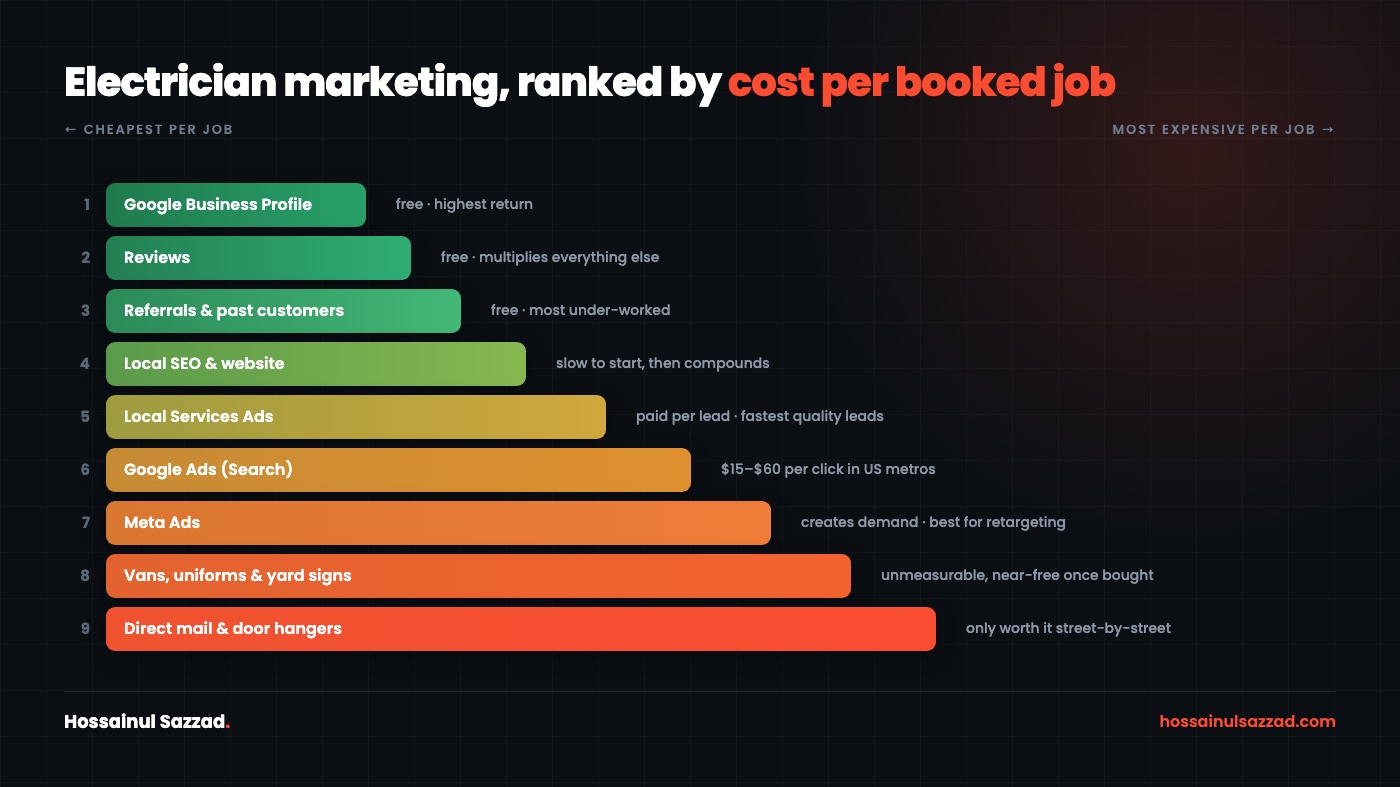
An electrical contractor in Arizona told me last year that marketing didn't work for him. He'd tried "everything", a $600-a-month directory listing, vehicle wraps, a Facebook page, a batch of door hangers, and Google Ads that ran for six weeks.
When I asked which of those produced his last ten jobs, he couldn't answer. Not because he was careless, because nothing was tracked. He was buying channels and hoping.
So this is not a list of marketing ideas. It's the nine channels I actually see working for electrical contractors, ranked by what they cost per booked job, which is the only number that decides anything.
Rank the channels by cost per booked job, not by cost
The mistake almost every contractor makes is comparing channels by their invoice. A $2,000/month ad campaign looks worse than $300 of door hangers until you notice the campaign booked eleven jobs and the hangers booked one.
Two numbers make every decision for you:
- Cost per booked job = what you spent on a channel ÷ jobs it actually produced.
- Average ticket = what a job is worth to you. A service call at $250 and a panel upgrade at $3,500 justify completely different spend.
If you can't attribute jobs to channels yet, fix that before spending another dollar. A separate phone number per channel and one question on every call, "how did you hear about us?", logged in a spreadsheet is enough to start.
1. Google Business Profile, the cheapest work you'll ever get
Free, and for most electricians it produces more booked jobs than every paid channel combined. When someone searches "electrician near me", three businesses get the map, the stars and a tap-to-call button. Everyone else is scrolling distance away.
Set your primary category to Electrician, fill in every field, list each service individually, add photos monthly. That's it. My 42-point Google Business Profile checklist covers each field, and if you're not appearing at all, start with why a business doesn't show up on Google Maps.
Cost per booked job: effectively your time. Nothing else comes close.
2. Reviews, the multiplier on everything else
97% of consumers read reviews before choosing a local business, and 41% now always do. Reviews aren't a channel so much as a tax on every other channel: weak reviews make your ads, your Map Pack position and your referrals all convert worse.
Build the request into your process rather than your memory, a text with your review link when the invoice is marked paid. Electricians who do that land four to eight reviews a month without thinking about it. Never offer discounts in exchange; that violates Google's policy and can get your profile suspended.
3. Referrals and past customers, the channel everyone under-works
Your existing customer list is the highest-converting audience you will ever have, and most electricians never contact it again. Two things worth doing:
- A short message to past customers when something seasonal is relevant, storm season, holiday lighting load, EV charger rebates in your state.
- An actual referral ask, once, a week after the job: "if you know anyone who needs work like this, I'd appreciate you passing my number on." Awkward for about four seconds, and it works.
General contractors, realtors, property managers and home inspectors belong in this bucket too. One good GC relationship can be worth more than a year of ad spend.
4. Local SEO and your website, slow, then compounding
Ads stop the day you stop paying. Rankings don't. A site with a dedicated page for each job you want (panel upgrades, EV charger installation, rewiring, generator installs) plus genuinely local city pages, keeps producing calls for years.
It takes four to eight months in an average US market, which is why it should run underneath ads rather than instead of them. The whole process is written out step by step in my 21-step electrician SEO guide.
Cost per booked job: high in month two, very low by month twelve.
Not sure which channel is actually working for you?
Send me your business name and city. I'll check where you rank across your service area, what your profile and reviews look like next to your top three competitors, and tell you which channel I'd put the next dollar into. Free, no call required. If you'd rather see how I run all of this as an ongoing engagement, that's on my electrician marketing services page.
Get My Free Marketing Review5. Local Services Ads, the fastest quality leads
Google's Local Services Ads sit above everything else, carry the Google Guaranteed badge and charge per lead rather than per click. For electricians they're usually the cheapest quality leads available, and you can dispute bad ones for a refund, which most contractors never bother doing.
The limits are real: only certain categories and service areas, and no control over your messaging. Treat them as the emergency-demand channel and cover everything else with Search.
6. Google Ads, buy the jobs you want, not the jobs you get
Search ads let you pick exactly which work you're bidding on. That's the whole point: you can spend only on panel upgrades and EV chargers and ignore $90 outlet replacements entirely.
It's also unforgiving. Trades clicks run $15–$60 in competitive US metros, so a poorly built campaign burns a month's budget quietly. Negatives, tight ad groups, a landing page per campaign and call tracking are the difference between $300 and $1,300 per lead. That's what my Google Ads management for contractors page covers in detail.
7. Meta Ads, for demand that doesn't exist yet
Nobody scrolls Facebook looking for an electrician. But a homeowner who's been ignoring a flickering panel for six months might act when they see a before/after of a job you did two streets over, with a seasonal offer attached.
Meta's other real use is retargeting people who visited your site and didn't call, the cheapest conversions in any account. I compared both platforms on real trades campaigns in Google Ads vs Meta Ads for home services.
8. Vans, uniforms and yard signs, cheaper than they look
A wrapped van parked on a residential street for four hours is local advertising you already paid for. Same with a yard sign during the job and a clean uniform at the door. None of it is measurable, all of it is close to free once bought, and it compounds with everything above, the homeowner who sees your van on Tuesday and your Map Pack listing on Friday is far more likely to call.
9. Direct mail and door hangers, targeted only
Blanket-mailing a ZIP code rarely pays for an electrician. Mailing the forty houses on the streets around a panel upgrade you just finished, with a line naming the job you did nearby, converts far better, because it carries local proof and arrives when neighbors have seen your van.
Use it as a neighborhood tool after a visible job, not as a volume channel.
What I'd skip
- Paid directory listings that don't send you the lead's contact details. If you can't call them back yourself, you're renting a customer.
- Shared lead platforms that sell the same homeowner to four electricians. You're competing on speed and price before you've said a word.
- Any agency selling "marketing" without saying which channels. Ask what you're buying. If the answer is vague, so is the work.
- Rebuilding your website before your profile and reviews are fixed. Expensive, slow, and it's rarely the bottleneck.
Where I'd start, in order
- Set up attribution so you can tell which channel books jobs. One week.
- Finish your Google Business Profile properly and start the review habit. One weekend.
- Ask your last twenty customers for a referral. One afternoon.
- Turn on Local Services Ads if you're eligible. Fast leads while the slow work builds.
- Start local SEO in the background. Four to eight months to matter, then it keeps paying.
- Add Google Ads for the high-ticket jobs you actually want more of.
Steps 1 to 3 are free and produce most of the early movement. That's not a sales pitch for doing nothing. It's the honest order.
Other trades
The same channel-by-channel breakdown for the other trades I work in: plumber marketing, where emergency and planned customers split the strategy in two, and pest control marketing, where recurring plans change what you can afford to pay for a customer.
Frequently Asked Questions
How much should an electrician spend on marketing?
The usual benchmark is 5–10% of revenue, rising to 10–15% while actively growing. For a US electrical contractor doing $1M a year that's roughly $4,000–$8,000 a month across everything. What matters more than the percentage is being able to attribute booked jobs to each line of it.
What's the cheapest way for an electrician to get more customers?
A fully completed Google Business Profile with steady recent reviews. It costs a few hours plus a habit, and for most electricians it produces more booked work than every paid channel combined. Second cheapest: asking past customers for referrals in a structured way.
Does direct mail still work for electricians?
Targeted mail does. Blanketing a ZIP code rarely pays, but a postcard to the specific streets around a panel upgrade or EV charger install you just completed, naming the job you did nearby, converts well because it carries local proof. It's a neighborhood tool, not a volume channel.
Is social media worth it for an electrical contractor?
As a trust asset, not a lead source. Few people scroll Instagram looking for an electrician, but plenty check whether you look real before calling. Recent job photos, your license number and a few reviews help you win calls that started elsewhere. Judge it on that, not follower count.
How do electricians get commercial clients instead of residential?
Commercial is a relationship channel, not a search channel, general contractors, property managers, facilities managers and your suppliers. Manufacturer preferred-contractor listings, local builder association events and one page on your site speaking to commercial scope and insurance limits beat any ad campaign.
Should I hire an electrician marketing agency or do it myself?
Do the free channels yourself, profile, reviews, referrals need consistency rather than expertise. Bring in help for paid campaigns, where a bad build wastes real money daily, and SEO, which depends on months of compounding work. Anyone bundling the free channels at agency prices is padding the invoice.

Local SEO & Paid Ads specialist for home service businesses in the US, UK and Canada. Google-certified, and behind results like 359K organic clicks for a UK retailer and a Texas electrical company's organic traffic doubling in six months.