 Hossainul Sazzad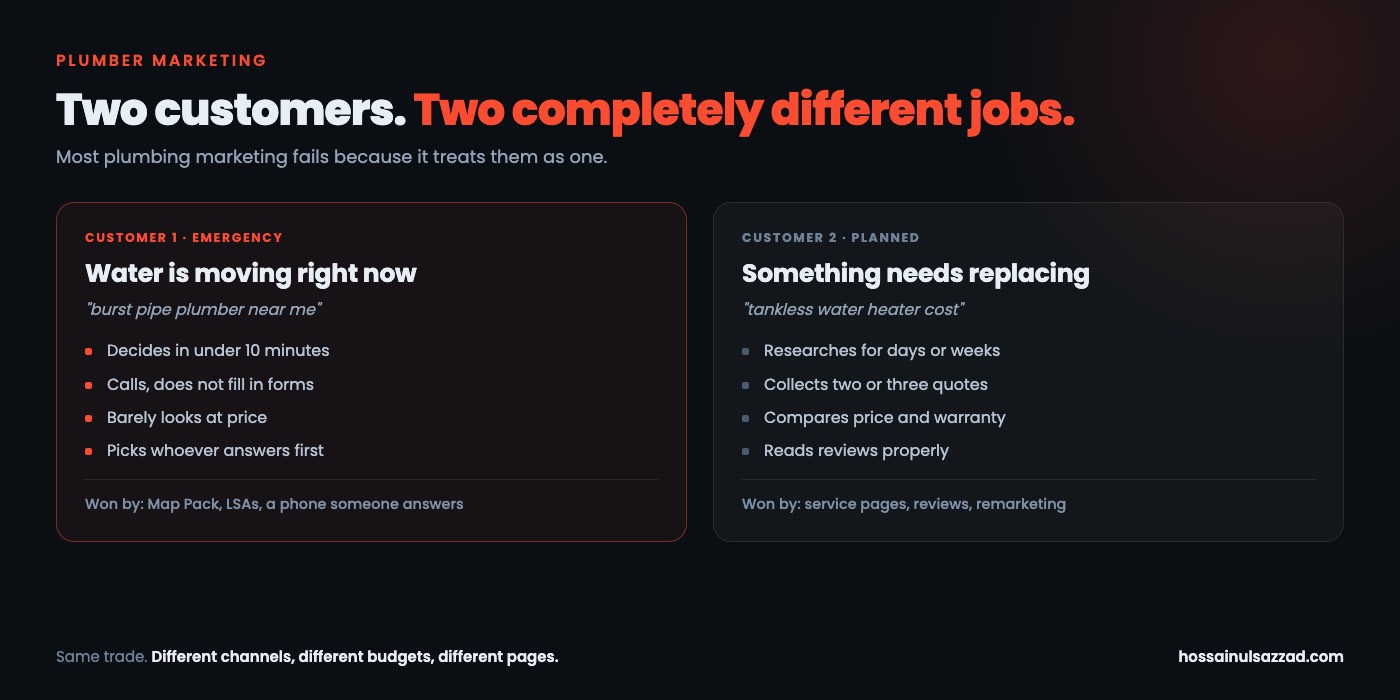
Plumbing is the most emergency-driven trade I work in, and that single fact breaks most of the marketing advice written for it.
A homeowner standing in two inches of water is not a "lead" in any normal sense. They will not fill in a form. They will not read your About page. They will call three numbers in ninety seconds and hire whoever picks up and can be there today. Price barely enters into it.
The same company also sells $6,000 repipes and $3,500 tankless installs to people who research for two weeks, collect three quotes and read every review you have. That customer is the opposite in every respect.
Marketing that works for one is close to useless for the other. So this is not a list of plumbing marketing ideas. It is which channels win each of those two customers, and what each costs per booked job.
Start by splitting your jobs in two
Before spending anything, sort last year's work into two buckets: emergency (burst pipes, blocked drains, no hot water, sewage backups) and planned (water heater replacement, repipes, filtration, remodels, inspections).
Two numbers matter for each: how many jobs, and the average ticket. Most single-van plumbing companies find that emergency work is the majority of jobs but a minority of revenue. That ratio tells you where the budget should go, and it is different for almost every company I look at.
If you cannot produce those two buckets, that is the actual first problem. Everything below assumes you can tell which channel produced which job, and that requires call tracking before it requires ad spend.
1. Google Business Profile, where emergency work is won
Someone with water on the floor opens Maps or types "plumber near me". They see three businesses. That is the whole competition, and being in it costs nothing but the work of maintaining the profile.
The things that move it for plumbers specifically:
- Primary category as Plumber, with secondary categories for the specific work you want (Drainage service, Water heater installation, Septic system service). The primary category is the single heaviest lever on the profile.
- Every service listed individually with its own description, not one "Plumbing Services" entry.
- Hours that reflect reality, including a 24-hour designation if you genuinely answer at 2am. Do not claim it if you do not, because the missed calls hurt you twice.
- Photos added weekly. Job photos, the van, the team. Profiles with recent photo activity consistently outperform static ones.
- Reviews, constantly, which is section two because it deserves it.
My full 42-point Google Business Profile checklist is the exact sequence I run, and it is free to work through yourself.
2. Reviews, the multiplier on everything else
Reviews are not a channel. They are the thing that decides whether every other channel converts. The same Map Pack position with 4.9 stars and 180 reviews versus 4.2 stars and 22 reviews produces completely different call volumes.
For plumbers there is a timing advantage most trades do not have: your customer is never more grateful than the moment the water stops. Ask then, on site, with a direct link. Not three days later in an email nobody opens.
Two rules that matter more than any script. Ask every customer, not the ones you predict will be kind, because self-selecting kills your volume. And respond to all of them. BrightLocal found 88% of consumers would use a business that responds to every review, against 47% for one that never responds. I keep response templates on the site if you want the wording.
Not sure where your plumbing jobs are actually coming from?
Send me your company name and city. I will check your Map Pack position across your service area, how your profile and reviews compare to your top three competitors, and where your site is losing calls. Free, and no call required.
Get My Free Plumbing Marketing Review3. Local Services Ads, the fastest emergency leads
Local Services Ads sit above everything, carry the Google Guaranteed badge, and charge per lead rather than per click. For emergency plumbing they are usually the cheapest quality leads available.
Two things decide whether they pay for themselves, and most companies get both wrong. Response rate: Google ranks you partly on how fast you answer, so a phone that rings out actively lowers your placement. And lead disputes: you can request refunds for wrong-number, out-of-area and spam leads, and almost nobody does it consistently. Over a year that is real money.
I compared them properly against standard search in Local Services Ads vs Google Ads, including eligibility and the order to run them in.
4. Google Ads, for the jobs you actually want
The advantage of paid search over LSAs is control. You can bid on "tankless water heater installation" and ignore "unclog toilet", which matters when one job is worth $3,500 and the other is worth $120.
The way plumbing accounts waste money is always the same: broad match picking up "how to fix a leaking tap", traffic landing on the homepage instead of a page about the specific job, and no call tracking, so nobody knows which keyword produced the phone call. Emergency and planned work should never share a campaign, a budget or a landing page.
What that management involves and what it costs is on my Google Ads management services page.
5. Local SEO and service pages, slow then compounding
This is where planned, high-ticket work is won. Someone researching a repipe reads for a week before calling anyone, and they are not reading your Google Business Profile.
Build a page per job, not per trade: water heater replacement, tankless conversion, repiping, drain and sewer, water filtration, gas lines. Each naming the job, the city, a real price range and what is included. Most plumbing sites have one "Services" page listing twelve things and rank for none of them.
It is slow. Three to six months before it carries weight. It is also the only channel that keeps producing after you stop paying, which is why I would never run ads without it building underneath. The full method is in my local SEO fundamentals for plumbers, the pricing side is in what local SEO costs for home services, and the service page is SEO for plumbers.
6. Meta Ads, planned work only
Let me save you some money: Meta will not fill your emergency schedule. Nobody scrolls Instagram and discovers a burst pipe. That is the most common way plumbing companies waste an ad budget.
Where it works is planned and seasonal: water heater replacement advertised before winter, filtration systems, bathroom remodels, and retargeting people who visited your site and did not call. That retargeting audience is consistently the cheapest conversion in the account. The detail is on my Meta Ads page.
7. Referrals and past customers, the channel nobody works
Your existing customer list is the cheapest pipeline you own and almost every plumbing company ignores it. A homeowner who had a drain cleared two years ago is a water heater customer now and does not know it.
Two low-effort things: a short seasonal message when something is genuinely relevant (freeze warnings, water heater age, rebate programmes in your state), and a referral ask at the point of payment when satisfaction is highest. Neither requires a budget.
8. Vans, uniforms and yard signs
Cheaper per impression than anything digital, and permanently underrated. A wrapped van parked outside a job for six hours in a neighbourhood where every house has the same plumbing and the same age of water heater is genuinely targeted advertising.
It will not be attributable, which is why marketers dismiss it. Ask new callers how they heard about you and you will find out.
What I would skip
- Paid directory listings charging monthly for a profile. You are renting a lead that is sold to two other plumbers simultaneously.
- Buying leads from shared lead-gen platforms as your main channel. Fine for filling a gap this week, terrible as a strategy, because the day you stop paying you have nothing.
- Blog posts about "10 signs you need a plumber". Nobody searching that is about to hire you, and it will not rank anyway.
- A full website redesign as step one. Usually the site does not need rebuilding, it needs service pages and a phone number that is tappable on a phone.
Where I would start, in order
- Call tracking, so the rest of this is measurable at all.
- Google Business Profile, completed properly, categories first.
- A review request that goes out on site, every job.
- Local Services Ads if emergency work is your bread and butter and the schedule has gaps.
- Service pages for your three highest-ticket planned jobs.
- Google Ads on those high-ticket terms only, once the pages exist to send them to.
That order is deliberate. Each step makes the next one cheaper.
Frequently Asked Questions
How much should a plumber spend on marketing?
A common working range is 5–10% of revenue, toward the higher end while you are still building visibility. For a single-van company that is usually $1,500–$4,000 a month across everything including ad spend. What matters more than the percentage is knowing which part produced last month's jobs, and most plumbing companies cannot answer that because nothing is tracked.
What is the best marketing channel for plumbers?
For emergency work, the Google Business Profile and Map Pack, because that is where someone with water on the floor looks first and it costs nothing but maintenance. Local Services Ads sit above it and charge per lead. For planned work like repipes, service pages and reviews do more, because those customers research for days. Rank channels by cost per booked job, not by cost.
Do plumbers need a website if they have a Google Business Profile?
Yes. Google reads your website to decide what your profile is relevant for, so a profile without a matching site plateaus outside the top three. The site also does what the profile cannot: a homeowner choosing between three plumbers for a $6,000 repipe wants to see the work, the warranty and a price range first. The profile gets you found, the site gets you chosen.
Are Local Services Ads worth it for plumbers?
For emergency plumbing, usually yes, they are often the cheapest quality leads available. Two things decide it: your response rate, since Google ranks you partly on how fast you answer, and whether you actually dispute bad leads. Most companies never do, and those refunds add up over a year.
How long does plumber SEO take to work?
Google Business Profile and Map Pack changes can move in 30–60 days. Website rankings for service and city pages take three to six months, longer in a dense metro. If you need calls this week, run Local Services Ads or Google Ads while the organic work builds underneath.
Should plumbers advertise on Facebook?
Not for emergencies. Nobody scrolls Instagram and discovers a burst pipe, and that is the most common way plumbing companies waste money on Meta. It works for planned and high-ticket jobs: water heater replacement, repipes, filtration, remodels, plus retargeting site visitors who did not call. That retargeting audience is the cheapest money in the account.
How do plumbers get more Google reviews?
Ask when the customer is most relieved, right after you have stopped the leak and cleaned up, not three days later by email. Send a direct link, not instructions. Ask every customer rather than the ones you think will be kind, and respond to all of them. Recency and volume both feed Map Pack ranking.
Want to know which channel to fund first?
Tell me your city and roughly what your emergency-to-planned job split looks like. I will tell you honestly where I would put the next dollar, including when the answer is fixing your Google Business Profile for free rather than hiring me.
Ask Me Where to Start
Local SEO & Paid Ads specialist for home service businesses in the US, UK and Canada. Google-certified, and behind results like 359K organic clicks for a UK retailer and a Texas electrical company's organic traffic doubling in six months.