 Hossainul Sazzad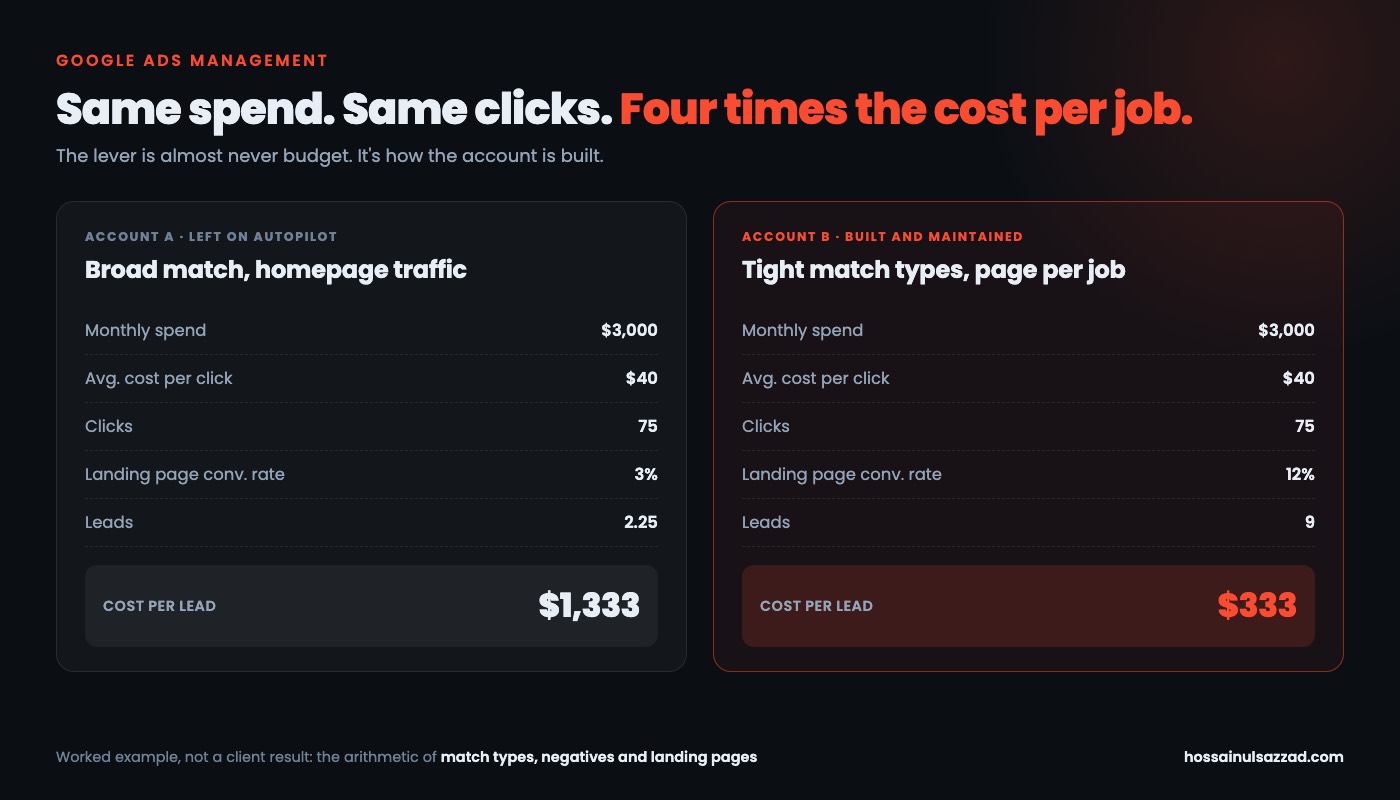
Here is the uncomfortable arithmetic of paid search. Two accounts spend $3,000 a month. Both pay about $40 a click, so both get roughly 75 clicks. One sends that traffic to a homepage and converts 3%. The other sends it to a page about the exact job the person searched for and converts 12%.
Account A pays $1,333 per lead. Account B pays $333. Identical spend, identical traffic, four times the cost.
That gap is what Google Ads management is actually for. Not the budget, the build.
What Google Ads management services actually include
The phrase covers wildly different amounts of work depending on who is selling it, so here is what I mean by it:
- Account and campaign structure. Separate campaigns by intent and margin, emergency work, high-ticket jobs and routine service should never share a budget or a bid strategy, because they don't share a customer.
- Match types and negative keywords. The highest-return hour in any account, every week, forever. The search terms report tells you exactly which searches wasted money, and most accounts have never had it read.
- Landing pages that match the search. One page per campaign, naming the service, the city and a real price range, with a tap-to-call button above the fold.
- Conversion and call tracking that is verified. Calls over 60 seconds counted, form fills deduplicated, offline conversion import where your CRM supports it. Without this Google optimises toward cheap clicks, because cheap clicks are all it can see.
- Ad copy written and tested. Not one ad per group left running for two years.
- Bid and budget reallocation. Moving money toward what booked, away from what didn't.
- A monthly report in plain language. Spend, leads, cost per booked job, and what I changed. Not a 40-page dashboard export nobody opens.
If a proposal doesn't name the search terms report and conversion tracking specifically, assume the account will be left on autopilot with a screenshot attached each month.
What Google Ads management costs
Keep two numbers separate, because conflating them is how businesses end up unsure what they're paying for. Ad spend goes to Google. Management goes to whoever runs the account. There are three common management models:
- Percentage of spend: typically 10–20%. Fits accounts spending over about $5,000 a month.
- Flat monthly fee: typically $500–$1,500 for a single-location business. Predictable, and usually the better deal below $5,000 in spend.
- Hybrid: a smaller base fee plus a lower percentage.
I'll say the quiet part about the percentage model: it rewards your manager for spending more of your money. Good optimisation frequently means spending less for the same number of jobs, and a percentage fee punishes exactly that. It's defensible at large budgets where workload genuinely scales with spend. At $2,000 a month it mostly isn't.
Below roughly $1,000 a month in ad spend, paid management rarely pays for itself. There isn't enough conversion data to optimise on, and the fee eats the budget. Put the money into the ads and read the search terms report yourself. I've told people this and lost the work, and it was still the right answer.
Want to know where your budget is leaking?
Give me access to your Google Ads account and I'll go through the search terms report, your negatives, your conversion setup and your landing pages, then tell you the three changes that will drop your cost per booked job fastest. Free, and if the account is already in good shape I'll say so rather than invent problems.
Get My Free Account ReviewThe first 90 days
- Days 1–7: Account audit or fresh build. Conversion and call tracking verified end to end, not assumed. Negative keyword lists loaded. Local Services Ads verification started if you're eligible.
- Days 8–30: Campaigns live, landing pages published, search terms reviewed every second day. This early window is where the bulk of wasted spend gets cut.
- Days 31–60: Bid and budget reallocation toward what actually booked. Ad copy testing. First full report with cost per lead and cost per booked job.
- Days 61–90: Scale what works, cut what doesn't, and test one new campaign type with a capped budget, Performance Max only once there's a steady conversion volume for it to learn from.
Leads normally arrive in week one. Efficiency arrives around day 45. Anyone promising both on day one hasn't run enough accounts.
A managed account, with real numbers
This is a Search campaign I manage, a screenshot from the account, not a stock claim:
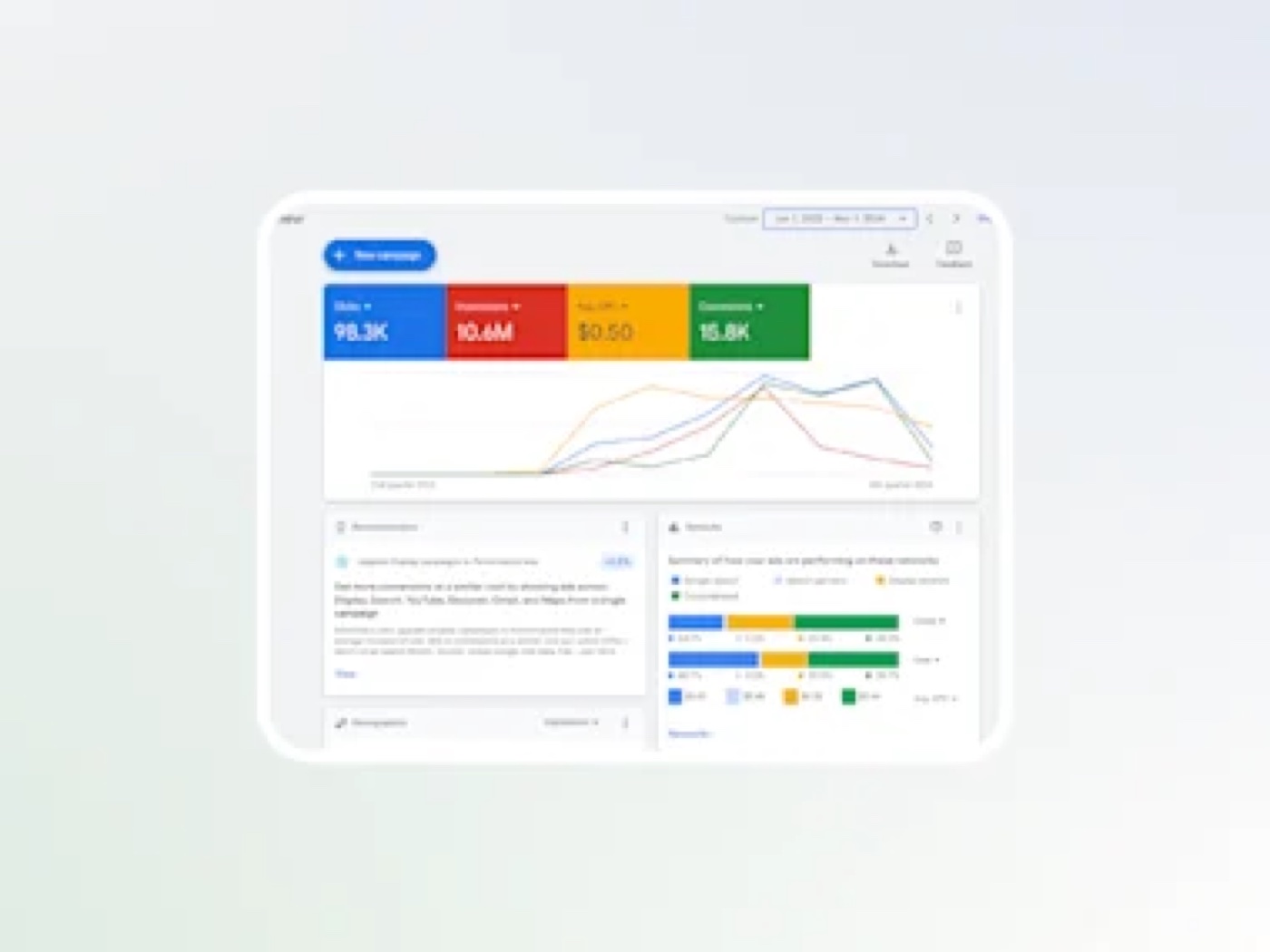
98.3K Clicks, 15.8K Conversions
What I can't show you is fifty of these. I'm one person and I work with a small number of businesses at a time, if a management company shows you fifty logos, ask to speak to three of their current clients.
Freelancer, agency, or do it yourself
An honest read on all three, including where I'm the wrong choice:
- A Google Ads management company gives you capacity, several people, cover when someone's away, and the bench to handle a multi-location or multi-country rollout. If you're spending $20,000 a month across fifteen locations, hire one.
- A solo specialist gives you the person who does the work. No handoff to a junior once the contract is signed, and a straight answer when something isn't working. For a single-location business under about $10,000 a month in spend, this is usually better value.
- Doing it yourself genuinely works if you'll put in the hours. Reading the search terms report and adding negatives isn't difficult. It's relentless, and that's why people stop. Fix broad match, stop sending paid traffic to your homepage, and verify your conversion tracking, and you'll beat a lot of paid management.
One thing to check with anyone you hire: make sure the Google Ads account, the tracking and the landing pages are yours and stay yours if you leave. Some agencies run campaigns inside their own account, so leaving means starting from zero. Ask directly, before signing.
Who I work with
Mostly home service businesses, where I know the demand curves and the keywords well:
- Contractors and home services, the trade-specific version of this page, including Local Services Ads
- Electricians · HVAC companies · Plumbers · Pest control
- Electrician marketing, where paid sits alongside everything else
- Meta Ads, Facebook and Instagram, the demand-creation half of paid
- SaaS companies, a newer vertical for me, and the page says so plainly
If ads and SEO are competing for the same budget, I wrote up Local Services Ads vs Google Ads and Google Ads vs Meta Ads from real campaigns, and what local SEO costs for the organic side.
Frequently Asked Questions
What do Google Ads management services actually include?
Account structure and campaign builds, keyword and match type selection, ongoing negative keyword work from the search terms report, ad copy writing and testing, landing page direction, conversion and call tracking setup, bid and budget management, and a monthly report. If a proposal doesn't name the search terms report and conversion tracking specifically, the account is likely being left on autopilot.
How much do Google Ads management services cost?
Three models. Percentage of spend is typically 10–20%, which suits accounts over about $5,000 a month. A flat fee of $500–$1,500 suits smaller accounts and is more predictable. Hybrid is a smaller base plus a lower percentage. Below roughly $1,000 a month in spend, management rarely pays for itself, put the money into the ads instead.
Is a percentage of ad spend or a flat fee better?
A flat fee is usually better for the advertiser. Percentage of spend rewards your manager for spending more of your money, which is the opposite of the incentive you want, good optimisation often means spending less for the same result. Percentage makes sense at higher budgets where workload genuinely scales with spend.
What's the difference between Google Ads and AdWords management services?
Nothing, same service. Google renamed AdWords to Google Ads in 2018, but many businesses still search for "adwords management services" and plenty of agencies still use the old name. If a provider's site still says AdWords everywhere in 2026, ask when their material was last updated.
How long before a managed account becomes profitable?
Clicks and calls usually start in week one, because you're buying demand that already exists. Efficiency takes longer, expect 30–60 days of search term mining, negatives, bid adjustments and landing page testing before cost per booked job settles.
Should I hire a Google Ads management company or a freelancer?
A company gives you capacity, several people and cover when someone's away. A solo specialist gives you the person who actually does the work, with no handoff to a junior. For a single-location business under about $10,000 a month in spend, solo is usually better value. Above that, capacity starts to matter more.
Do I keep my Google Ads account if I stop working with you?
Yes, and check this with anyone you hire. The account, conversion tracking, landing pages and historical data should live in an account you own, with your manager given access. Some agencies run client campaigns inside their own account, so leaving means starting from zero. Ask before you sign.
Can I manage Google Ads myself instead?
Yes, if you'll genuinely put in the hours. Reading the search terms report and adding negatives isn't technically hard. It's relentless, which is why people stop. Most self-managed accounts lose money on three things: broad match left unchecked, paid traffic pointed at the homepage, and conversion tracking nobody verified.
Not sure ads are even your next dollar?
Tell me your business, your city and roughly what a job is worth to you. I'll tell you honestly whether Google Ads, local SEO or just a better Google Business Profile is where I'd spend first, including when that isn't the thing I'd be selling you.
Ask Me Where to Spend First