 Hossainul Sazzad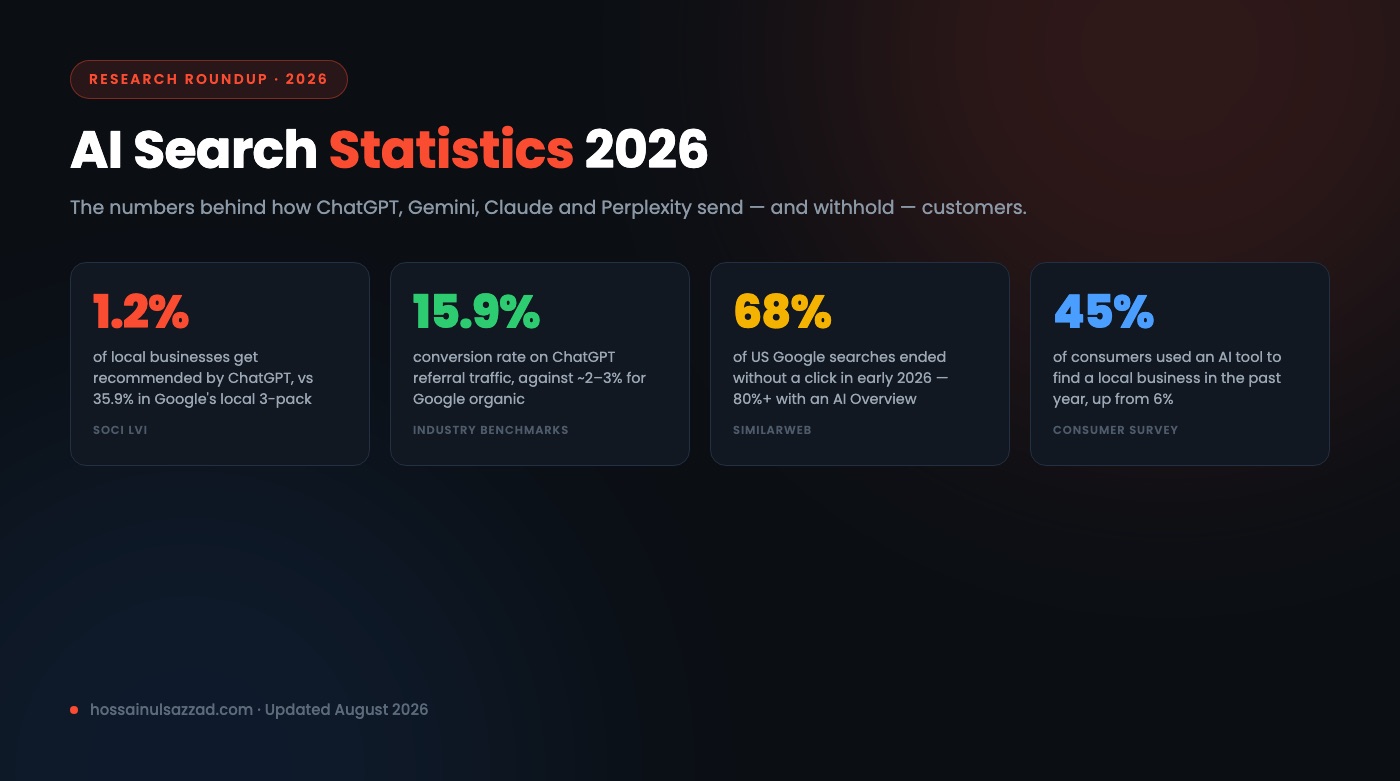
I got tired of chasing down the same statistics every time I wrote a proposal, so I built this page for myself and left it public. Every figure below links to where it came from, and where credible sources disagree, which happens more than most stat roundups admit. I've said so rather than picking the number that sounds best.
Use anything here, with attribution. If you're citing a figure for a client deck or an article, follow the link and check the original: several of these are moving fast enough that a six-month-old number is already wrong.
Adoption: how many people actually search this way
- Roughly one third of the US population is expected to use generative AI search in 2026, per eMarketer.
- 45% of consumers used an AI tool to find a local business in the past year, up from about 6% the year before.
- 64% adoption among 30–44 year olds, the highest of any age band. For home service businesses that is precisely the homeowner demographic booking work.
- ChatGPT's share of generative AI web traffic fell from ~76% to ~53% year over year, while Gemini passed 25% and Claude became the category's fastest-growing platform (Similarweb). The market is diversifying, optimising for one assistant is no longer a strategy.
Zero-click: the reason impressions rise but clicks don't
- About 68% of US Google searches ended without a click in the first four months of 2026 (Similarweb).
- That climbs to 80–83% on searches showing an AI Overview.
- Practical consequence I see in nearly every Search Console account I open: impressions grow, clicks flatten. Judge progress by position on commercial queries, not by impression count.
Conversion: the counter-argument to the zero-click panic
Fewer clicks, but far better ones. This is the most commercially important cluster on the page, and also the one where sources vary most, so here is the range rather than a single tidy number.
- ChatGPT referral traffic converts at about 15.9%, Perplexity around 10.5%, Claude around 5.0% (Demand Local).
- Google organic sits near 1.8–2.8% depending on the dataset used for comparison.
- A study of 312 B2B firms by Opollo found 14.2% for AI referrals versus 2.8% for Google organic.
- Averaged across industries, AI referral traffic converts 4–5× better than organic search (AirOps).
- Caveat worth citing alongside these: some analysts argue the gap is inflated by attribution, AI referrals are disproportionately branded, bottom-of-funnel visits, so they were always going to convert well. Both things are true: the traffic is small, warm, and worth having.
- ChatGPT accounts for roughly 87.4% of average AI referral traffic across industries (Conductor). Whatever the other assistants do for brand visibility, ChatGPT is where measurable sessions come from today.
- AI referral share varies enormously by sector, Real Estate ~1.01%, Financials ~0.48%, Communication Services ~0.25% of traffic. One benchmark does not fit every industry.
AI Overviews: what gets cited
This is where I'd urge the most caution. Two credible-sounding figures circulate and they point in opposite directions, because they measure different things.
- 76.1% of URLs cited in AI Overviews also rank in the top 10 of classic results. I.e. most cited pages are already ranking pages.
- 59.6% of AI Overview citations come from URLs not ranking in the top 20: i.e. a majority of individual citations reach outside the first two pages.
- Both can hold at once: a small number of top-10 pages get cited repeatedly, while a long tail of lower-ranked pages supplies the bulk of distinct citations. The practical read: ranking helps, but directly answering the question can get you cited without it.
- Which is why every page I build now answers its core question in the first two sentences and uses real FAQ sections with FAQPage structured data.
Local business visibility: the hardest numbers in this list
- SOCi's Local Visibility Index analysed 350,000+ business locations.
- ChatGPT recommends only 1.2% of them.
- 35.9% appear in Google's local 3-pack: meaning AI local visibility is roughly 30× harder to earn than a Map Pack placement.
- Only ~45% overlap between businesses winning the Map Pack and businesses AI tools recommend. More than half of top-3 Google Maps businesses are invisible to AI.
- 60–70% of the local businesses ChatGPT surfaces first come from Foursquare's Places API: a listing most trades businesses have never claimed.
- Perplexity leans on live web search plus partnerships (including Yelp for local) and heavily weights community sources like Reddit.
- Gemini and AI Overviews read Google's own data first. Your Google Business Profile is effectively their input.
- Claude has no business dashboard at all; it relies on the open web, entity clarity and structured data. An
llms.txtfile and clean schema are the levers there.
Want to know what AI says about your business?
Every free audit I deliver includes an AI visibility check, what ChatGPT, Gemini and Perplexity actually say when a customer asks for your trade in your city, plus the fixes that get you named.
Get My Free AI Visibility AuditReviews and trust signals
- Businesses AI tools recommend average 4.3+ stars across multiple platforms: breadth, not just a high Google rating.
- 88% of consumers are likely to use a business that responds to all of its reviews, versus 47% for one that never responds (BrightLocal). See my review response templates for the practical side.
- Businesses that began responding to reviews saw more reviews and higher average ratings afterwards (Harvard Business Review).
Three numbers I'd argue matter most
- 1.2% vs 35.9%. The AI leaderboard in your city is essentially unclaimed. That gap is the opportunity, and it will close.
- 45% overlap. Winning Google is not the same job as winning AI. Budget for both.
- 15.9% vs ~2%. A small stream of AI referrals can outproduce a much larger stream of organic clicks. Measure AI visibility in booked jobs, not sessions.
How to cite this page
Please link to the original source for any individual statistic. I've linked all of them above. If you're citing the collection itself:
Hossainul Sazzad, "AI Search Statistics 2026: 32 Data Points, With Sources", hossainulsazzad.com, August 2026. https://www.hossainulsazzad.com/blog/ai-search-statistics
I update this page as new research lands. If you have a dataset that contradicts something here, send it to me. I'd rather have the page be right than tidy.
For what to actually do with these numbers, start with my AI search optimization guide for local businesses, or the platform-specific playbooks for ChatGPT, Gemini, Claude and Perplexity. If you'd rather have it handled, that's my AI search optimization service.
Frequently Asked Questions
What percentage of people use AI to search in 2026?
About a third of the US population is expected to use generative AI search this year (eMarketer), and 45% of consumers used an AI tool to find a local business in the past year, up from roughly 6%. Adoption peaks at ~64% among 30–44 year olds.
Does AI search traffic convert better than Google organic?
Yes in every published dataset, though the gap size varies: ChatGPT ~15.9%, Perplexity ~10.5%, Claude ~5.0% against ~1.8–2.8% for organic; one 312-firm B2B study found 14.2% vs 2.8%. Part of the gap is attribution, AI referrals skew branded and bottom-of-funnel.
How many Google searches end without a click in 2026?
Around 68% of US searches in the first four months of 2026, rising to 80–83% when an AI Overview appears (Similarweb). This is why impressions can climb while clicks stay flat.
Do businesses that rank on Google get recommended by AI?
Often not. SOCi found ChatGPT recommends 1.2% of 350,000+ locations versus 35.9% appearing in the local 3-pack, with only ~45% overlap, more than half of Map Pack winners are absent from AI answers.
Which AI assistant sends the most referral traffic?
ChatGPT, at roughly 87.4% of average AI referral traffic (Conductor), even though its share of overall generative AI web traffic fell from ~76% to ~53% as Gemini passed 25%.

Local SEO & Paid Ads specialist for home service businesses in the US, UK and Canada. Google-certified, and behind results like 359K organic clicks for a UK retailer and a Texas electrical company's traffic doubling in 6 months. Every audit now ships with an AI visibility check.