 Hossainul Sazzad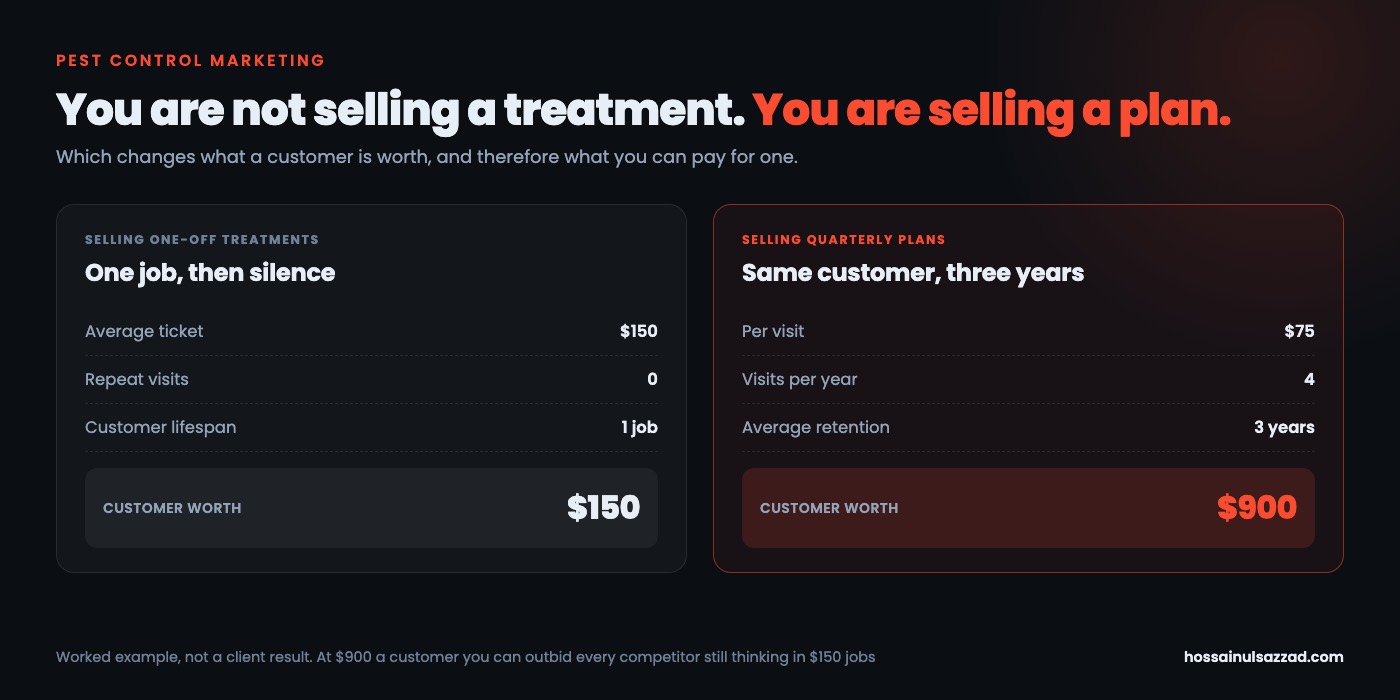
Pest control has an economic advantage almost no other home service trade has, and most pest control marketing throws it away.
An electrician sells a panel upgrade and may not hear from that customer for six years. A plumber fixes a leak and disappears. But pest control has a natural, honest reason to come back every quarter, forever. That turns a one-time job into a subscription.
Work the arithmetic. A one-off treatment at $150 is a $150 customer. The same household on a quarterly plan at $75 a visit, staying three years, is a $900 customer. Same person, same first phone call, six times the value.
That number is the entire strategy, because it decides what you can afford to pay to acquire a customer. A competitor still thinking in $150 jobs cannot bid against you, cannot outspend you and cannot out-wait you. Everything below follows from that.
(Those figures are a worked example to show the mechanism, not a client result. Put your own numbers in, because your retention rate is the variable that matters most.)
Know your real cost per acquisition ceiling
Before choosing channels, work out one number: what a plan customer is worth over their lifetime with you. Average plan value per year, times realistic retention in years, times your gross margin.
That is your ceiling. If a plan customer is worth $900 in revenue at a 50% margin, you have $450 of gross profit and can rationally spend a meaningful share of it acquiring one. Most pest control companies I speak to have never calculated this and are unconsciously capping their ad spend at the value of a single treatment.
The two levers that move the number are not marketing at all. They are what percentage of one-off jobs convert to plans, and how long plans last before cancelling. A five-point improvement in either is worth more than doubling your ad budget.
1. Google Business Profile, where urgent pest work is won
Pest problems are urgent, local and visual. Someone who has just found droppings in a cupboard opens Maps. Three businesses appear. That is the competition, and entering it costs nothing but maintenance.
What matters specifically for pest control:
- Pest control service as the primary category, with secondaries for the specialisms you actually want called about (Animal control service, Termite inspection).
- Each pest listed as its own service with a description. Bed bugs, termites, rodents, wasps, ants, cockroaches. People search by pest, not by "pest control".
- Photos of real work, including treatment and inspection shots. This is a trade where visible evidence reassures a nervous customer.
- Reviews mentioning specific pests, which happens naturally when you ask right after solving a specific problem.
The full sequence is in my 42-point Google Business Profile checklist.
2. Pest-specific service pages, not one "Services" page
This is the single biggest on-site gap I see in this trade. Most pest control sites have one page listing every pest. It ranks for none of them.
Someone searching "bed bug treatment cost" and someone searching "termite inspection near me" are different customers with different urgency, different price expectations and different objections. They need different pages, each naming the pest, the city, what the treatment involves, roughly what it costs and how long it takes.
Termite work deserves particular attention because it is high ticket, heavily researched and often triggered by a property sale with a deadline attached. That customer will read everything before calling.
The full method is in my pest control SEO fundamentals, the service side is on my pest control SEO page, and the wider pricing picture is in what local SEO costs for home services.
Want to know why your competitors outrank you?
Send me your company name and city. I will check your Map Pack position across your service area, how your profile and reviews compare with the top three, and which pest pages your competitors have that you do not. Free, and specific.
Get My Free Pest Control Marketing Review3. Reviews, and asking at the right moment
Pest control has an unusually strong review moment. Relief is immediate and emotional, and people talk about it. Ask on site, once the problem is visibly handled, with a direct link rather than instructions.
Ask every customer rather than the ones you expect to be complimentary. Respond to all of them. BrightLocal found 88% of consumers would use a business that responds to every review, against 47% for one that never does. If you want the wording, my review response templates are free to copy.
4. Google Ads, for the urgent pests only
Paid search works here because pest emergencies are genuinely urgent and people click the first credible result. But the budget should be pointed narrowly.
Bid on the pests that pay: termites, bed bugs, rodents, wasp nests. Add heavy negatives for the DIY searches, which are the biggest source of wasted spend in this trade. "How to get rid of ants naturally" is not a customer, and broad match will find that query relentlessly.
Separate campaigns by pest, because cost per click and job value vary enormously between a wasp nest and a termite treatment. What that management involves is on my Google Ads management services page.
5. Seasonality, worked ahead rather than during
Pest demand is more predictable than almost any other trade, and most companies still advertise into the peak, when the auction is at its most expensive and every competitor is bidding.
Termite swarms, ants and wasps warming up in spring, rodents moving indoors as it cools. These are known months ahead. Publish the page and start the campaign a few weeks early, when clicks are cheaper and you catch the research phase rather than the panic phase.
Seasonality also gives you the most natural recurring-plan pitch there is: the problem is coming back next year whether they book or not.
6. Meta Ads, for plans rather than emergencies
Nobody scrolls Instagram and discovers they have termites. But pest control is one of the better trades for Meta, because the recurring plan is exactly the kind of product that suits demand creation: preventative, seasonal, and easy to explain in an image.
Target homeowners in your service area ahead of the season, and retarget people who visited a pest page and did not call. That retargeting audience is consistently the cheapest conversion in any account. Detail is on my Meta Ads page.
7. Past customers, the plan pipeline you already own
Every one-off treatment you have ever done is a plan customer who has not been asked. That list is the cheapest recurring revenue available to you and most companies never touch it.
A short seasonal message when something is genuinely relevant, referencing the actual problem you solved for them, converts better than any cold campaign. It costs nothing.
What I would skip
- Paid directory listings that charge monthly and sell the same lead to two competitors.
- Generic blog content like "5 signs you have pests". Nobody searching that is hiring, and it will not rank. Pest identification pages are the exception, because someone searching what a specific bite looks like has the problem now.
- Competing on national brand terms. Expensive, and you will lose. Win the Map Pack in your towns instead.
- Discounting the first treatment without a plan attached. You are buying a $150 customer at a loss instead of a $900 one.
Where I would start, in order
- Calculate what a plan customer is worth to you. Everything else depends on this number.
- Google Business Profile, completed properly, every pest listed as a service.
- A review request on site, every job.
- Pages for your three highest-value pests, named by pest and city.
- A plan offer scripted for whoever is on site, made at the moment the problem is solved.
- Google Ads on urgent, high-value pests only, once those pages exist.
Notice that only one of those six is an advertising channel. In this trade the conversion from job to plan is worth more than the traffic.
Frequently Asked Questions
How much does pest control marketing cost?
Most single-location companies run $1,500–$5,000 a month across everything including ad spend. The better way to set it is backwards from what a customer is worth. If a plan customer is worth several hundred dollars in lifetime value rather than the price of one treatment, you can afford a much higher acquisition cost than a competitor still thinking in single jobs. That is usually the real advantage, not budget size.
What is the best marketing channel for pest control?
The Google Business Profile and Map Pack, because pest problems are urgent and local and that is where people look first, and it costs nothing but maintenance. After that it depends on the job: paid search for urgent pests like wasps and rodents, service pages and reviews for termite inspections and recurring plans that people research first.
How do pest control companies get more recurring customers?
Sell the plan when the problem is solved, not in the ad. Someone who has just watched you deal with an infestation is far more receptive than a cold prospect. Train whoever is on site to offer it, price the first plan visit close to the one-off treatment so switching is easy, and have a page that explains what the plan includes so they can check later.
Is pest control marketing seasonal?
Heavily, and the mistake is advertising during the peak rather than ahead of it. Demand climbs with temperature, so the auction is most expensive exactly when everyone is bidding. Termite swarms, spring ants and wasps, and rodents moving indoors as it cools are all predictable months ahead. Starting a few weeks early costs less and catches the research phase.
Should pest control companies use Google Ads or SEO?
Both, in that order, if the schedule has gaps. Ads produce calls in days because you are buying existing demand, which suits urgent pests. SEO takes three to six months but keeps producing after you stop paying, and it is where plan and termite customers are won. Run ads while local SEO builds underneath, then reduce spend on terms you now rank for.
How do I compete with the big national pest control brands?
Not on brand terms, which are expensive and unwinnable. Compete where nationals are weak: the Map Pack in your specific towns, pest-and-city pages like bed bug treatment in a named city, and review volume, which is local and cannot be bought nationally. Homeowners often pick the local company with 200 recent reviews over a national call centre, but only if you are visible.
Do pest control companies need a blog?
Only for content a paying customer would search. Identification pages work, because someone searching what a specific bite or droppings look like has the problem right now. Generic advice posts do not, because nobody searching them is close to hiring. If a post cannot be tied to a service you sell in a city you cover, it is probably not worth writing.
Not sure whether to fund ads or fix the basics?
Tell me your city and what share of your customers are on recurring plans. I will tell you honestly which one I would spend on first, including when the answer is that your Google Business Profile is the cheapest fix available and you do not need me for it.
Ask Me Where to Start
Local SEO & Paid Ads specialist for home service businesses in the US, UK and Canada. Google-certified, and behind results like 359K organic clicks for a UK retailer and a Texas electrical company's organic traffic doubling in six months.