 Hossainul Sazzad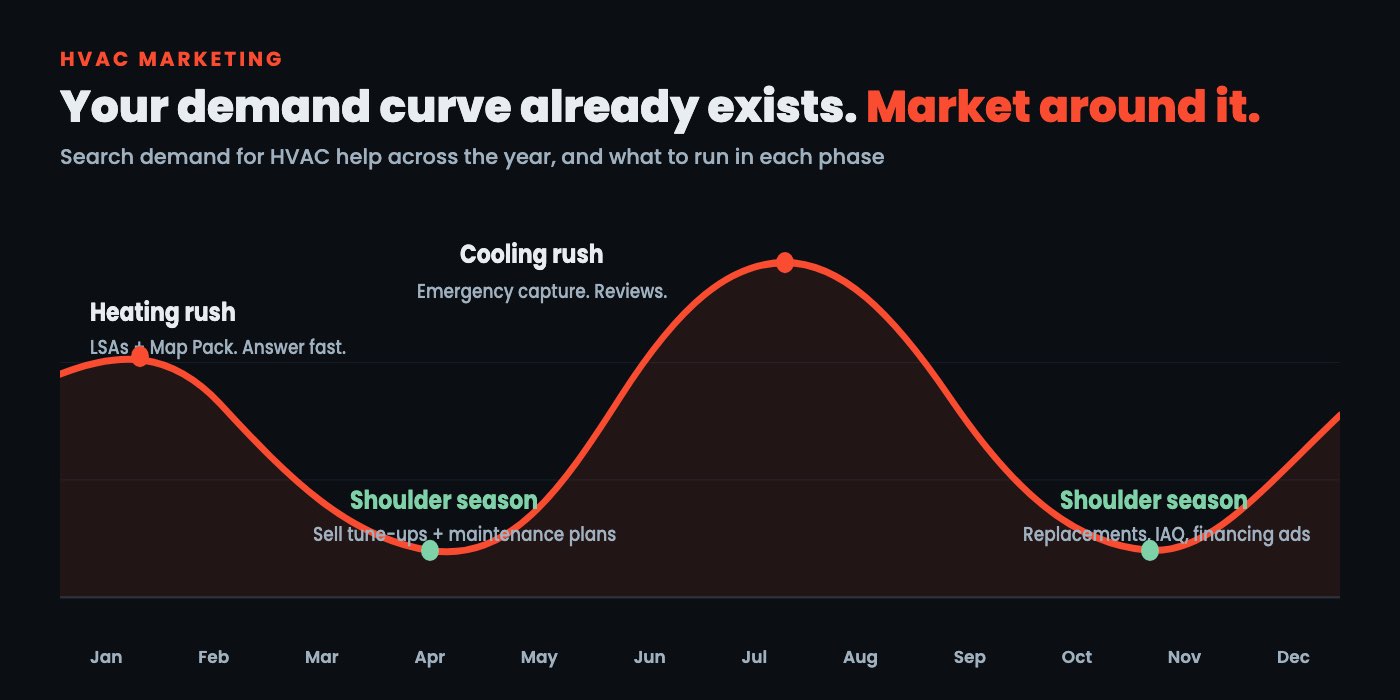
Every trade I work with has a quirk that breaks generic marketing advice. For electricians it is that half the work is invisible to homeowners. For plumbers it is the emergency customer. For HVAC it is the calendar.
No other home service swings this hard. In July, during a heat wave, you turn work away. In April, the phone can go a full day without ringing. The revenue difference between an HVAC company's best and worst month is routinely three or four to one.
Most HVAC marketing ideas ignore this completely. They hand you a flat list of channels, as if a lead in July and a lead in April were the same thing. They are not. In July you are rationing capacity. In April you are buying work. A marketing plan that does not change with the season is wrong for most of the year.
So this is not a list of tactics. It is the demand curve above, phase by phase, with the channels that win each one and what they cost.
Read your own curve first
Before spending anything, pull last year's jobs by month and split them into three buckets: emergency repair (no cooling, no heat), planned replacement and installs, and maintenance. Almost every HVAC company finds the same shape: repairs spike with the weather, replacements cluster just before and after the spikes, and maintenance is whatever you made happen.
That last clause is the whole game. The rushes market themselves; the weather is your advertising. The companies that struggle are not losing the summer, they are losing March, April, September and October. Everything below is organised around that.
1. Google Business Profile: where the rush is won
When the AC dies in a heat wave, the homeowner opens Google, types "ac repair near me", and calls one of the three companies in the Map Pack. Price barely enters into it; speed does. Being one of those three costs nothing but the work of maintaining the profile.
What moves it for HVAC specifically:
- Primary category HVAC contractor, then secondaries for the jobs you want: Air conditioning repair service, Furnace repair service, Heating contractor. The primary category is the heaviest single lever.
- Every service listed individually, with its own description. "AC repair", "AC replacement", "furnace repair" and "duct cleaning" are different searches; one "HVAC Services" entry ranks for none of them.
- Real hours, updated for the season. If you run extended summer hours, the profile should say so, because "open now" is a filter people use at 8pm in July.
- Photos weekly during the rush. Installs, the van, the crew. Profiles with recent activity consistently outperform static ones.
My 42-point Google Business Profile checklist is the exact sequence I run, free to work through yourself.
2. Reviews: the multiplier, with a seasonal twist
Reviews decide whether every other channel converts. In BrightLocal's consumer review survey, the overwhelming majority of consumers read reviews before choosing a local business, and responsiveness to reviews measurably changes who they pick.
The HVAC-specific move is to harvest reviews during the rush. Summer is when you have the most grateful customers you will see all year: you gave a family their cooling back on a 100-degree day. Ask that day, on site, with a direct link to the review form. A rush season worked properly should add 30 to 50 reviews, and that stockpile is what wins the comparison shopping of the shoulder season, when replacement customers read every word. Response wording is on my review response examples page if you want templates.
Not sure where your HVAC jobs are actually coming from?
Send me your company name and city. I will check your Map Pack position across your service area, how your profile and reviews compare to your top three competitors, and where your site is losing calls. Free, and no call required.
Get My Free HVAC Marketing Review3. Local Services Ads: pay per lead when it matters
Local Services Ads sit above everything else, carry the Google Guaranteed badge, and charge per lead rather than per click. For emergency repair calls in season they are usually the cheapest quality leads you can buy.
Run them with two habits. Answer fast, because Google ranks providers partly on responsiveness, and a phone that rings out actively lowers your placement. And dispute junk leads for refunds, which almost nobody does consistently; over a year it is real money. In the shoulder months, watch the per-lead price weekly. Paying July lead prices for April tune-up calls is how LSA budgets quietly die. I compared LSAs against standard search in detail in Local Services Ads vs Google Ads.
4. Google Ads: expensive clicks, so aim them
HVAC clicks are among the most expensive in home services; my keyword pulls routinely show $20 to $40 per click on repair and replacement terms in US metros. That does not make Google Ads a bad channel. It makes untargeted Google Ads a catastrophic one.
The discipline is seasonal and structural. Separate campaigns for repair and replacement, never sharing a budget. Repair campaigns get their budget in the rush, when a $35 click becomes a $400 same-day ticket. Replacement campaigns run in the shoulder months against searches like "ac replacement cost", landing on a page about that exact job with a price range and financing, not the homepage. And call tracking on everything, or you will never know which half worked. What proper management involves is on my Google Ads management services page.
5. SEO and service pages: plant in spring, harvest in July
Organic rankings are slow, three to six months for service and city pages, which for HVAC is not a weakness but a timing instruction: SEO started in early spring is ranking by the summer rush, and the summer rush is when it pays for the entire year.
Build a page per job, not per trade: AC repair, AC replacement, furnace repair, heat pump installation, duct sealing, indoor air quality. Each naming the job and the city with a real price range. Replacement customers research for weeks, and the company whose site answered their cost questions is the one that gets the quote request. The local fundamentals are in local SEO for HVAC companies, the full playbook is in my HVAC SEO guide, and the done-for-you version is SEO for HVAC companies. What it should cost is covered in local SEO pricing for home services.
6. Maintenance agreements: the only channel that flattens the curve
Everything above rides the demand curve. Maintenance agreements are the one channel that reshapes it, which is why I treat them as marketing and not just operations.
A member has pre-committed to two visits a year, in months you choose, which fills exactly the shoulder weeks that every other channel struggles with. A member whose system is dying calls you first, without shopping, so every agreement is a pre-sold replacement lead walking around your service area. This is why the whole plan should funnel into the agreement: the summer repair customer gets the membership pitch at the moment of relief, the tune-up ad in April sells the plan and not just the visit, and the renewal email goes out before the season, not after it lapses.
Price it to be easy to say yes to. The agreement's job is not margin on the visits; it is owning the customer when the $8,000 decision arrives.
7. Meta Ads: shoulder season work only
Nobody discovers a broken air conditioner while scrolling Instagram, so Meta will not fill an emergency schedule, and an honest plan says so. Where Meta earns a place in HVAC is the planned side of the calendar: replacement offers with financing in spring and fall, indoor air quality, duct cleaning, and maintenance plan campaigns, aimed at homeowners in your service area. Retargeting people who visited your replacement pages and did not call is consistently the cheapest conversion in the account. The mechanics are on my Meta Ads page.
8. Your past customers: the cheapest leads you own
An HVAC company's customer list ages into revenue on a schedule you can almost set your watch by. ENERGY STAR's guidance is to consider replacement once an AC or heat pump passes roughly ten years; you know the install date of every system you have ever touched. A customer you repaired twice last summer is a replacement quote waiting for a reason.
Two sends carry most of the value: a pre-season tune-up offer to the whole list in March and September, and a specific replacement conversation with owners of systems past the ten-year mark. Neither costs more than the time to write them, and both consistently outperform any cold channel on cost per booked job.
What I would skip
- Shared lead platforms as a main channel. The same lead sold to three competitors, in a trade where speed decides. Fine to fill a dead week, terrible as a strategy.
- Radio and billboards before digital is fixed. Brand awareness is real, but not while your Map Pack position is fourth and your reviews are two years old.
- Blog posts like "10 signs you need a new AC". National sites own those rankings, and the reader is not hiring anyone today.
- A website rebuild as step one. The site usually needs service pages and a tappable phone number, not a redesign.
The plan, in calendar order
- Call tracking first, so every step after this is measurable.
- Google Business Profile completed properly, categories and services first. Do it now, whatever month it is.
- A review request that fires the day of every job, so the coming rush builds your stockpile.
- Service pages for your replacement jobs, started a season before you need them to rank.
- Local Services Ads switched on for the rush, with disputes worked weekly.
- A maintenance agreement worth buying, pitched at the end of every rush-season job.
- Shoulder season money into replacements: Google Ads on cost searches, Meta with financing offers, and the pre-season email to your list.
That order is deliberate. Each step makes the next one cheaper, and the whole thing repeats every year with less effort than the year before.
Frequently Asked Questions
How much should an HVAC company spend on marketing?
A common working range is 5–10% of revenue, higher while you are still building visibility. For a two-van company that usually lands between $2,000 and $5,000 a month including ad spend. The number that matters more is how the budget moves through the year: front-load ads into the rushes, and shift money into maintenance plan promotion during the shoulder months instead of cutting to zero.
What is the best marketing channel for HVAC companies?
During a heat wave or cold snap, the Google Business Profile and Map Pack, because a homeowner with no cooling calls one of the three businesses they see first. Local Services Ads sit above that and charge per lead. In the shoulder seasons the answer changes: replacement and IAQ work is won by service pages, reviews and remarketing. There is no single best channel, only a best channel per season.
How do HVAC companies get leads in the slow season?
Sell what the season actually contains. Spring and fall are when sensible homeowners service equipment and replace dying systems before the rush, so push tune-up offers, maintenance agreements and replacement quotes with financing. Your past customer list is the cheapest source: a system you repaired twice is a replacement lead, and a tune-up email to old customers costs nothing.
Are Local Services Ads worth it for HVAC companies?
In the rush seasons, usually yes: top placement, the Google Guaranteed badge, and per-lead pricing suit emergency calls. Two habits decide profitability: answer fast, because Google ranks partly on responsiveness, and dispute junk leads for refunds. In the shoulder season, review the per-lead price weekly, because rush prices for tune-up calls rarely pay.
How long does HVAC SEO take to work?
Google Business Profile improvements can move the Map Pack inside 30–60 days. Website rankings for service and city pages take three to six months, longer in big metros. The practical implication is timing: SEO started in early spring is ranking by the summer rush, which is when it pays for the whole year.
Should HVAC companies run Facebook ads?
Not for emergency work; nobody discovers a broken AC while scrolling. Meta earns its budget on the planned side: replacements with financing, indoor air quality, duct cleaning and maintenance plans in the shoulder months, plus retargeting site visitors who did not call. The retargeting audience is consistently the cheapest conversion in the account.
Why do maintenance agreements matter for HVAC marketing?
They are the only channel that flattens the demand curve instead of riding it. Members fill the shoulder season with pre-committed visits, call you first when the system dies, and make every agreement a pre-sold replacement lead. Every other channel should feed the agreement, not just the one-off job.
What HVAC marketing tools do I actually need?
Fewer than the industry sells you. The non-negotiables: call tracking numbers per channel, a review request flow that fires the day of service, and whatever field software you already run. Add tools when a specific measurement is missing, not because a vendor bundled them.
Want to know which channel to fund first?
Tell me your city and roughly how your year splits between repairs, replacements and maintenance. I will tell you honestly where I would put the next dollar, including when the answer is fixing your Google Business Profile for free rather than hiring me.
Ask Me Where to Start
Local SEO & Paid Ads specialist for home service businesses in the US, UK and Canada. Google-certified, and behind results like 359K organic clicks for a UK retailer and a Texas electrical company's organic traffic doubling in six months.