 Hossainul Sazzad
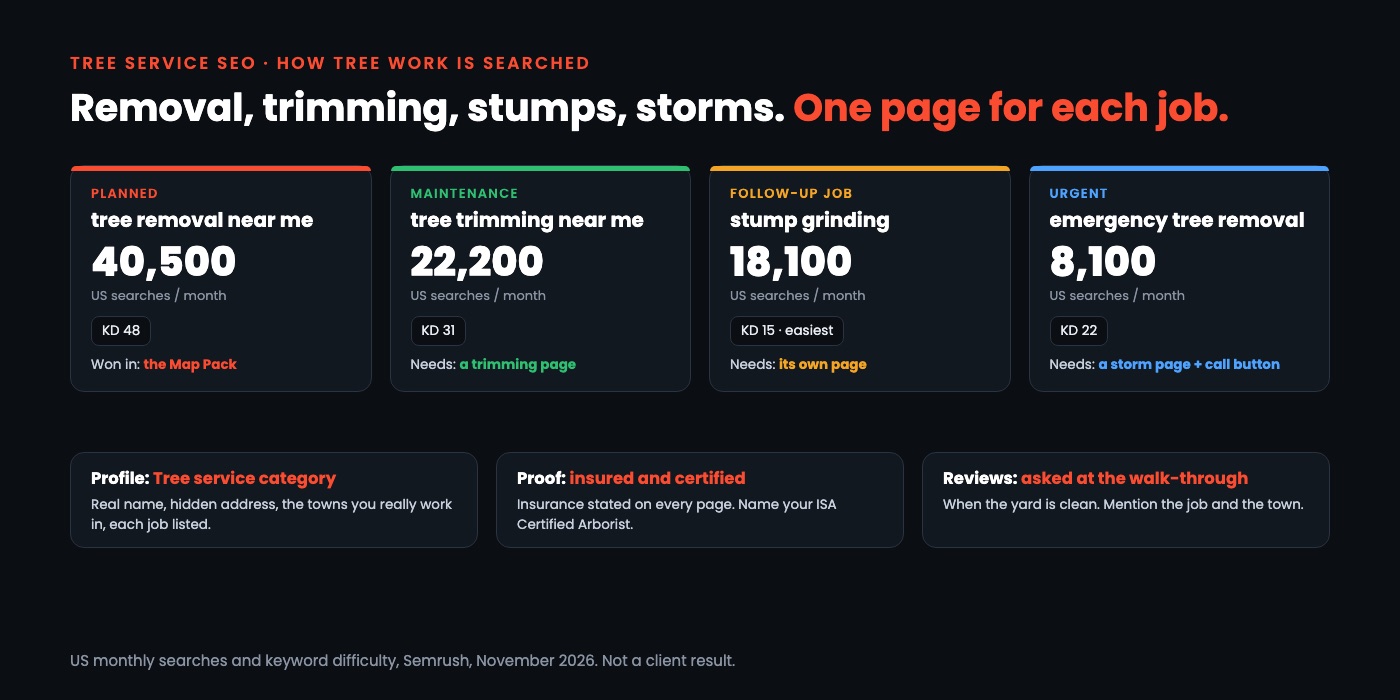
A storm goes through on a Tuesday night. By Wednesday morning a homeowner is looking at a large limb across the driveway and searching "emergency tree removal" on a phone. Three weeks later a different homeowner, in no hurry at all, searches "stump grinding" because the stump from last year is still in the lawn. Both are tree work. They are completely different searches, and most tree company websites are built for neither.
That is the core of tree service SEO. The trade has an urgent side and a planned side, a few very large "near me" searches that are won in the Map Pack, and a handful of easy job searches that almost nobody builds a page for.
I should say plainly where I stand: my published case studies are with electricians and other home service trades, not with a tree company. What follows is the same local SEO method I use across home services, adapted to how tree work is actually searched, quoted and chosen.
How homeowners search for tree work
These are US monthly search volumes from Semrush. I pulled them on November 8, 2026 for my home service keyword study, which covers eight trades:
| Search | Kind of job | US searches / month | KD |
|---|---|---|---|
| tree service near me | General | 60,500 | 47 |
| tree removal near me | Planned removal | 40,500 | 48 |
| tree trimming near me | Maintenance | 22,200 | 31 |
| stump grinding | Follow-up job | 18,100 | 15 |
| emergency tree removal | Urgent | 8,100 | 22 |
KD is Semrush's keyword difficulty score out of 100. Three things stand out.
- The big "near me" searches are Map Pack searches. "Tree service near me" and "tree removal near me" are hard as organic keywords (KD 47 and 48), but a homeowner who types them mostly sees three local businesses on a map. Your Google Business Profile and your reviews decide those, not a blog post.
- Stump grinding is the open door. 18,100 searches a month at KD 15 is one of the easiest large keywords in the whole study. Many tree companies mention stump grinding in one line on a services page. A proper page for it is realistic to rank, even for a newer site.
- Emergency work is smaller but urgent. "Emergency tree removal" has fewer searches, a lower difficulty (KD 22), and a customer who calls the first business that looks able to come today.
Local SEO for tree service: the Google Business Profile
Google says local results are based mainly on relevance, distance and prominence. You cannot change where the customer is standing, so the work is on the other two. For a tree company the profile basics are:
- Business name: your real name, as it appears on your trucks and invoices. Google's profile guidelines do not allow added keywords or towns. "Best Cheap Tree Removal Tulsa" is the kind of name a competitor reports.
- Category: usually Tree service as the primary category, because it matches the largest searches. Add secondary categories only for work you really do. Type the word into the category field and read the options, because Google adds and renames categories.
- Address and service area: most tree companies travel to the customer, which makes them a service-area business. Google's guidelines say such a business should hide its address, and it allows up to 20 service areas, within roughly two hours of driving from your base. List the towns you really work in. A wider area on the profile does not make you rank across it.
- Services: list each job separately in the homeowner's words: tree removal, tree trimming, stump grinding, emergency tree removal, land clearing if you do it. One line each, with a short plain description.
- Photos: this is a visual trade. The crane on a tight removal, the bucket truck, the crew in helmets, the clean yard afterwards. Add new ones every month from real jobs.
- Hours: if you take storm calls at night, say so. If you do not, do not claim it. Missed calls from a "24 hours" listing become one-star reviews.
The field-by-field version is in my Google Business Profile optimization checklist. If your profile exists but does not appear at all, start with why a business does not show up on Google Maps.
Tree removal SEO: one page for each job
Most tree company sites have a home page, an about page and one "Services" page that lists everything. Google matches a search to a page, so that single page competes for five different searches and wins none of them. Each job you want more of needs its own page.
The pages I would build first:
- Tree removal: the main money page. Explain how you price (height, trunk size, access, what is underneath, whether a crane is needed), what happens to the wood and debris, and whether stump grinding is included or quoted separately. Homeowners search for cost constantly, so a page that explains the price factors honestly earns trust before the quote.
- Tree trimming and pruning: a different buyer, who wants the tree kept healthy and safe. Say when you recommend trimming, what you will not do to a tree, and how often it usually needs repeating.
- Stump grinding: the easy keyword from the table. Cover how deep you grind, what happens to the chips, access width for the machine and whether you take stump-only jobs from trees someone else removed. Many companies do not want that work. If you do, this page can be your cheapest source of calls.
- Emergency and storm damage: a short, urgent page with a tap-to-call button at the top, your real response area, and a plain note on working with the homeowner's insurance company if you do that.
- Land and lot clearing: only if you do it. It is a different customer (builders, new owners of acreage) and deserves its own page.
Every page needs your main town in the title and heading, real photos of that job, two or three reviews that mention it, and a phone number that works with one tap. If you serve several towns, a page for each main town is worth building only when you can put something real on it: jobs you did there, photos, a review from that town. Thin copies with the town name swapped do not help.
Is your tree service website missing these pages?
Send me your website and the towns you work in. I will check your Google Business Profile, which job pages are missing, your reviews and your page speed, and send the three fixes that matter most. Free, within 24 hours.
Get My Free Tree Service SEO AuditSEO for arborists: show the proof homeowners look for
Tree work is dangerous, and homeowners know that a tree dropped on a roof becomes their problem if the company is not insured. OSHA keeps a dedicated tree care industry safety page covering falls, falling objects and work near power lines. So before a homeowner compares prices, they check whether you look like a real, insured, trained company.
Put that proof where they can see it, on the home page and on every service page:
- Insurance: say that you carry liability insurance and workers' compensation, and that you send a certificate on request. Then do it quickly when asked.
- Credentials: if someone on your crew is an ISA Certified Arborist, name them and link to the credential. The International Society of Arboriculture describes certification as a voluntary process that documents a tree care professional's knowledge, and it tells homeowners to look for it. If nobody on the crew is certified, do not use the word arborist loosely.
- Licences: some states and cities license tree work. If yours does, show the number.
- Equipment and crew: real photos of your own trucks, chipper and people, with safety gear on. Stock photos of a stranger with a chainsaw do the opposite of what you want.
This helps with Google as well as with people. Named credentials, a consistent business name and real photos are the kind of evidence that separates an established company from a new listing with nothing behind it.
Reviews: ask while the yard is clean
BrightLocal's Local Consumer Review Survey 2026, a panel of 1,002 US consumers, found that 74% look for reviews written in the last three months, and 47% will not use a business with fewer than 20 reviews. A tree company with 14 reviews from two years ago is losing calls to a competitor with 60 recent ones, whatever the quality of the work.
The best moment to ask is the walk-through at the end of the job, when the tree is gone and the yard is raked. Ask in person, then text the review link before the truck leaves. Ask the customer to mention the job and the town in their own words ("removed a dead oak over our garage in Edmond"). Those words help you appear for the same search later.
Reply to every review, briefly. Tree work produces complaints about lawn ruts, missed debris and scheduling after storms. If you need wording for those, I collected tested replies in Google review response examples.
Storm season and the planned season
Tree work has two rhythms. Storm damage arrives without warning and all at once. Planned work, such as trimming, removals and stump grinding, follows the local climate and the homeowner's calendar.
SEO cannot be switched on the day a storm hits. A page published that morning will not rank by the afternoon. The emergency page, the profile and the reviews have to be in place weeks before, so the work for storm season is done in the quiet months. That is the opposite of how most tree companies handle marketing, which is to think about it only when the phone stops ringing.
During a storm week, the useful things are small: update your profile hours if you are working extended days, post a short update with a real photo, and answer the phone. If you want calls sooner than SEO can bring them, paid search fills the gap. How I set that up for trades is on my Google Ads for contractors page.
Local links for tree companies
Links from other local and trade websites are part of what Google calls prominence. Most tree companies have very few, and the trade has natural sources:
- Credential directories: ISA runs a public Find an Arborist directory where credential holders manage their own profile. If you hold a credential, complete yours.
- Trade associations: the Tree Care Industry Association and state arborist associations list member companies.
- Referral partners: landscapers, roofers, fence companies, property managers and insurance restoration firms all meet customers who need a tree removed first. Many keep a list of recommended vendors on their site.
- Equipment and supply dealers: some list the local companies they serve. Ask.
- Local organisations: a sponsored youth team, a donated tree planting or a neighbourhood clean-up after a storm earns a link from a site Google already trusts in your town.
Skip paid link packages and bulk directory submissions. They do not move a local business. Landscaping shares many of the same partners and the same seasonal pattern, and I covered that trade in SEO for landscapers.
Tree service SEO mistakes I see most
- One services page for everything. Removal, trimming, stump grinding and emergency work each need a page.
- No stump grinding page. The easiest large keyword in the trade, left on the table.
- No proof of insurance anywhere on the site. In a trade where the homeowner's roof is at risk, silence reads as a warning.
- Keywords or towns added to the business name on Google. Easy to report and a common reason for suspension.
- A service area that covers half the state. You rank near your base and where your jobs and reviews are, not across every town you typed in.
- Stock photos. Your own crew and equipment are your best sales tool.
- A slow site. Storm searches happen on a phone, sometimes on a weak signal. Run your site through my free SEO audit tool and fix the load time first.
What tree service SEO costs
For a single-location home service business, honest local SEO retainers usually run $750–$2,500 a month, depending on the size of the market and how much needs building. A two-crew company in a small town with a clean profile sits at the low end. A company chasing removals across a metro area sits higher. The full breakdown, including what you can do yourself, is in how much local SEO costs for home services.
Expect the Map Pack to respond first, often within the first few months if the profile and reviews were weak, and the service pages to take longer. Anyone who promises a number one position by a date is guessing.
Where this fits
Tree care follows the same local SEO foundations as every trade I work with: the profile, one page per job, recent reviews, local links and a fast site. How those parts fit together for any trade, and how I work, is on my SEO for contractors page.
Frequently Asked Questions
Is SEO worth it for a tree service company?
Yes, for a company with a defined service area. Tree jobs are high value, and the homeowner usually calls one of the first businesses Google shows. Ranking in the Map Pack and for job searches such as stump grinding or emergency tree removal brings those calls without paying for every click. It takes months, not days, so it works best as the steady base under any advertising you run.
How do tree service companies get more customers from Google?
Four things do most of the work. A complete Google Business Profile with the right category, real photos and each service listed. A separate page on the website for each job: removal, trimming, stump grinding and emergency work. A steady flow of recent reviews, asked for at the end of each job. And visible proof of insurance and credentials, because homeowners check for it before they call.
What Google Business Profile category should a tree service use?
Usually Tree service as the primary category, because it matches the largest searches. Add secondary categories only for work you actually do and can support with a page on your site. Google adds and renames categories over time, so type the word into the category field in your profile editor and read the options instead of copying a list from an old article.
What keywords should a tree service website target?
Start with the jobs. In Semrush US data from November 2026, tree service near me has about 60,500 searches a month, tree removal near me 40,500, tree trimming near me 22,200, stump grinding 18,100 and emergency tree removal 8,100. The near me searches are decided mostly in the Map Pack. Stump grinding and emergency tree removal have low difficulty scores, so a dedicated page for each is the realistic place to begin.
How long does tree service SEO take to work?
Google Business Profile improvements can show within the first few months, especially if the profile was incomplete or had few recent reviews. Service pages usually take longer to rank, and competitive cities take longer than small towns. Because of that delay, the work for storm season has to be done in the quiet months. A page published the day a storm hits will not rank that week.
How much does tree service SEO cost?
For a single-location home service business, honest local SEO retainers usually run $750 to $2,500 a month, depending on how competitive the city is and how much needs building. A small company in a small town with a clean profile sits at the low end, and a multi-crew company in a metro area sits higher. Very cheap packages usually mean automated directory submissions and little else.
Want this plan applied to your tree service?
Tell me your town, the jobs you want more of (removals, trimming, stump grinding or storm work) and how many crews you run. You will get your profile, pages and reviews checked against this plan, with the fixes in priority order.
Get My Free Audit
Local SEO & Paid Ads specialist for home service businesses in the US, UK and Canada. Google-certified, and behind results like 359K organic clicks for a UK retailer and a Texas electrical company's organic traffic doubling in six months.