 Hossainul Sazzad
It is 11 at night and someone is standing in a parking lot looking at their keys on the driver's seat. They search "car lockout" or "locksmith near me", tap the first business in the Map Pack that looks real, and call. They do not compare five websites. Whoever shows up first and looks trustworthy gets the job.
That is locksmith SEO in one scene. Most of the work is urgent, most of it starts on a phone, and the call goes to one of the three businesses Google shows. The rest of the work (car keys, rekeying after a move, commercial access control) is planned, worth more per job, and searched more than most locksmiths realise.
I should say plainly where I stand: my published case studies are with electricians and other home service trades, not with a locksmith. What follows is the same local SEO method I use across home services, adapted to how locksmith work actually comes in, and to the one problem that makes this trade different from every other: fake listings.
How people search for a locksmith
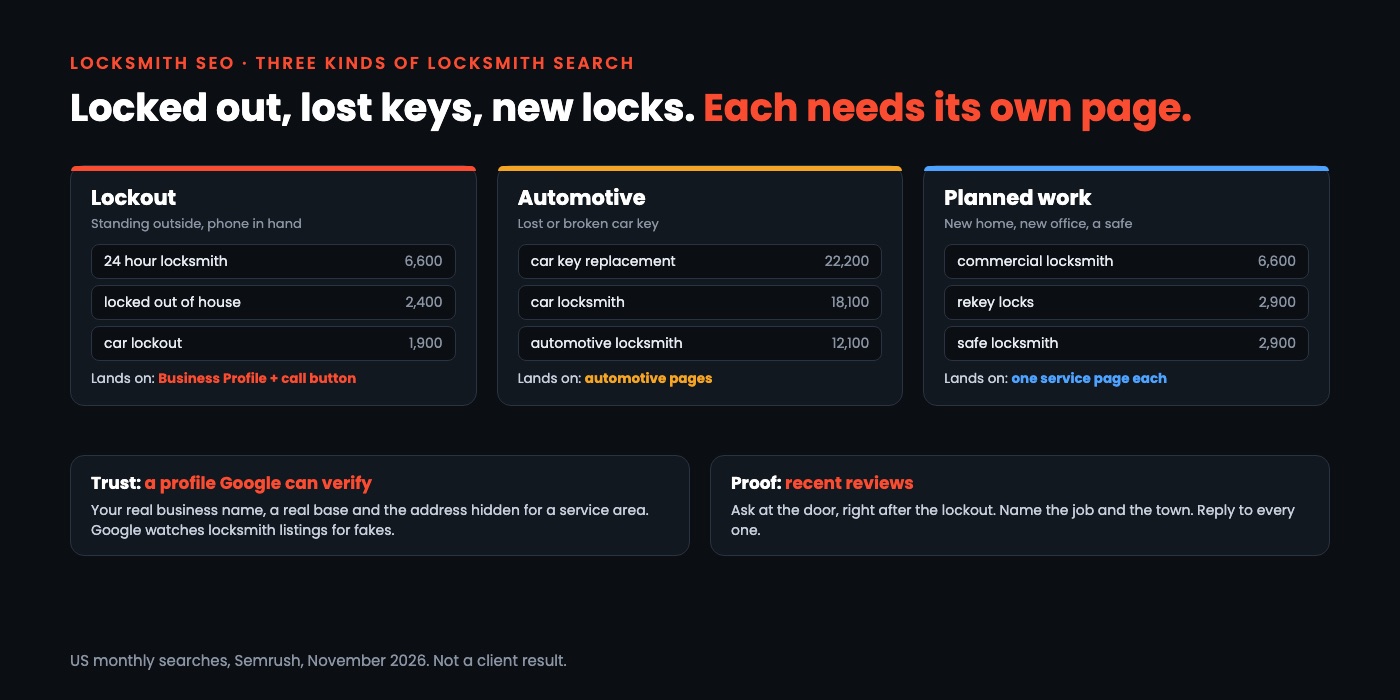
I pulled US search volumes for the main locksmith searches in Semrush in November 2026. They fall into three groups, and each group needs a different place to land:
| Search | Group | US searches / month | KD |
|---|---|---|---|
| locksmith near me | General | 301,000 | 57 |
| car key replacement | Automotive | 22,200 | 33 |
| car locksmith | Automotive | 18,100 | 23 |
| automotive locksmith | Automotive | 12,100 | 22 |
| emergency locksmith | Lockout | 8,100 | 38 |
| 24 hour locksmith | Lockout | 6,600 | 14 |
| commercial locksmith | Planned work | 6,600 | 19 |
| lockout service | Lockout | 3,600 | 25 |
| rekey locks | Planned work | 2,900 | 34 |
| safe locksmith | Planned work | 2,900 | 26 |
| locked out of house | Lockout | 2,400 | 15 |
| car lockout | Lockout | 1,900 | 8 |
- Lockouts: "24 hour locksmith", "locked out of house", "car lockout". Urgent, almost always won in the Map Pack, decided in seconds. Your Google Business Profile, your reviews and a phone number that gets answered do the work here.
- Automotive: "car key replacement", "car locksmith", "automotive locksmith". Bigger than most locksmiths expect, and the buyer has a little more time. Many of these people are comparing you with the dealership. A proper automotive page wins them.
- Planned work: "commercial locksmith", "rekey locks", "safe locksmith". New homeowners, landlords, property managers and offices. Not urgent, often recurring, and won by a dedicated service page for each job.
Look at the difficulty column. "locksmith near me" is huge but hard (KD 57), and it is decided almost entirely by the Map Pack. "car lockout" at KD 8, "24 hour locksmith" at KD 14 and "commercial locksmith" at KD 19 are the kind of searches a real local business can rank a page for. I published the wider version of this data, across eight trades, in my home service keyword study.
The fake listing problem, and why it shapes locksmith SEO
Every locksmith who has looked at their local Map Pack knows this one. Some of the "locksmiths" there are lead-generation call centres with a made-up name, a rented mailbox and a phone number that forwards to whoever buys the job. They quote low on the phone and charge far more at the door. It is an old problem in this trade, and it is why Google treats locksmith listings with more suspicion than most.
You can see that caution in Google's own rules. Its advertising policy lists locksmith services in the United States and Canada among the categories that must pass Advanced Verification before ads can run. On the organic side, the profile guidelines are the same for every trade, but in a category with this many fake listings, both Google and your competitors look closely at every locksmith profile.
For a real locksmith, this is good news in disguise. The fake listings are fragile: they get reported and removed, and they cannot build what a real business builds over time (genuine reviews from named customers, a website with real photos, local links, a consistent name across the web). Locksmith SEO done properly is mostly about making it obvious that you are the real thing.
Google Business Profile for locksmiths
For lockout searches, the Business Profile does more than the website. Google says local results are based mainly on relevance, distance and prominence. For a locksmith, the profile also has to survive scrutiny, so get the basics exactly right:
- Business name: your real name, as it appears on your van, invoices and license. Google's profile guidelines do not allow keywords or towns in the name. "24/7 Cheap Locksmith Dallas" is exactly the kind of name that gets reported by competitors and suspended.
- Address: most locksmiths travel to the customer, which makes you a service-area business. Google's guidelines say a service-area business should hide its address, and that virtual offices, remote mailboxes and P.O. boxes are not acceptable. If you work from home, use the home address and hide it. Do not rent a mailbox in a better part of town.
- Service area: Google allows up to 20 service areas and says the overall area should not stretch beyond about two hours of driving from your base. List the towns you really reach in a reasonable time. A lockout customer waiting 90 minutes will not leave a good review.
- Category: usually Locksmith as the primary. Add secondary categories only for work you really do and can back up with a page. Type the word into the category field and read the options; Google adds and renames categories.
- Hours: if you really answer at 2 a.m., say 24 hours. If you do not, do not. Missed night calls from a "24 hour" listing turn into one-star reviews.
- Photos: your van with the name on it, your tools, you at work. These are also what Google asks for when it verifies by video. Its video verification guide uses a locksmith as its example of a service-area business and asks to see the operating area, your professional equipment, and proof you run the business, such as a branded van.
The full field-by-field version is in my Google Business Profile optimization checklist.
Service pages that match the three kinds of search
Most locksmith websites have a home page and one "Services" page listing everything from lockouts to master key systems. That page ranks for none of them. Each kind of job you want more of needs its own page, because Google matches searches to pages.
The pages I would build first for most locksmiths:
- Emergency lockout service: home and car lockouts on one urgent page, with a click-to-call button at the top, your real response area and honest wording about arrival times. Mention "24 hour" only if it is true.
- Car key replacement and automotive locksmith: the biggest searches in the table. Say which kinds of keys and fobs you can cut and program, which makes and years you handle, and what the customer needs to have with them (usually proof of ownership). If you are often cheaper or faster than the dealership, say so plainly.
- Rekeying and lock changes: aimed at new homeowners and landlords. Explain the difference between rekeying and replacing locks in plain words; that alone answers a common search.
- Commercial locksmith: master key systems, access control, panic hardware, office lockouts. A different buyer (facilities managers, property managers) who values response time and paperwork.
- Safe services: only if you really open, move or install safes. It is a smaller search, but few local competitors cover it well.
Each page needs your main town in the title and heading, a price range or the factors behind the price, your license number if your state licenses locksmiths, two or three reviews that mention that job, and a phone number that is tappable on a phone.
Is your locksmith website losing calls?
Send me your website and the towns you serve. I will check your Google Business Profile, which service pages are missing, your reviews and your page speed, and send the three fixes that matter most. Free, within 24 hours.
Get My Free Locksmith SEO AuditPrices: the trust signal locksmiths avoid
The lead-gen scam in this trade runs on a low phone quote and a much higher bill at the door. That is exactly why honest pricing information on your site works so well. A customer who has heard about locksmith scams, or been caught by one, is looking for a business that explains what it charges before they arrive.
You do not need a fixed price list. A short section on each service page is enough: what the service call covers, what changes the price (time of night, type of lock, type of car key, distance) and a rough range for common jobs. Say that you confirm the total before you start work, and then do it. That one sentence separates you from the listings Google is trying to remove.
Reviews: recent, specific, asked for at the door
Locksmith customers read reviews quickly and with suspicion. BrightLocal's Local Consumer Review Survey 2026, a panel of 1,002 US consumers, found that 74% look for reviews written in the last three months, and 47% will not use a business with fewer than 20 reviews.
A lockout customer is never happier than in the minute after you get them back inside. Ask then, in person, and text the review link before you drive away. Ask them to mention what you did and where ("got me back into my car at the grocery store in Plano") in their own words. Specific reviews from named customers are exactly what the fake listings cannot produce.
Reply to every review, including the bad ones, briefly and without arguing. If you need wording for an angry review about price or arrival time, I collected tested replies in Google review response examples.
Local links for locksmiths
Links are part of prominence, and most local locksmiths have almost none. The trade has good natural sources:
- Trade associations: ALOA runs a consumer section for finding a qualified locksmith, and many states have their own locksmith associations.
- Suppliers and manufacturers: some lock and access control brands list authorised dealers or installers. Ask your distributor what you qualify for.
- Business partners: property managers, realtors, car dealers without their own key programming, auto repair shops and towing companies often keep a list of recommended vendors.
- Your licence listing: if your state licenses locksmiths, make sure your name and phone in the public record match your profile and website exactly.
- Local organisations: sponsoring a school or community event earns a link from a site Google already trusts in your town.
Skip paid link packages and bulk directory submissions. They do not move a local business, and in a trade Google already watches closely, they are the last thing you want attached to your name.
Locksmith SEO mistakes I see most
- Keywords or towns stuffed into the business name. Easy for a competitor to report, and a common route to suspension.
- A rented mailbox or virtual office as the address. Not allowed for a Business Profile, and a red flag in this trade in particular.
- Several profiles for one business. One business, one profile, unless you really have staffed locations.
- "24 hours" with nobody answering at night. The calls you miss become your worst reviews.
- One services page for everything. Car keys, rekeying and commercial work each need their own page.
- No prices and no explanation. In a trade known for bait-and-switch quotes, silence about price reads as a warning.
- A slow mobile site. Lockout searches happen on a phone, often with a weak signal. Run your site through my free SEO audit tool and fix the load time first.
What locksmith SEO costs
For a single-location home service business, honest local SEO retainers usually run $750–$2,500 a month, depending on the size of the market and how much needs building. A one-van locksmith in a small town with a clean profile sits at the low end; a company chasing automotive and commercial work across a metro area sits higher. The full breakdown, including what you can do yourself, is in how much local SEO costs for home services.
If you want calls while the SEO work builds, paid search can fill the gap, but expect the Advanced Verification step first. I explained the difference between Local Services Ads and regular search ads in Local Services Ads vs Google Ads, and how I set up search campaigns for trades in Google Ads for contractors.
Where this fits
Locksmithing follows the same local SEO foundations as every trade I work with: the profile, service pages, reviews, local links and a fast site. The overview of how those parts fit together for any trade, and how I work, is on my SEO for contractors page. Painting is a very different trade, but the same idea of one page per job drives it, and that version is in SEO for painters.
Frequently Asked Questions
Is SEO worth it for locksmiths?
Yes, for a real locksmith business with a defined service area. Locksmith searches are urgent and high intent: someone searching "car lockout" or "24 hour locksmith" usually calls one of the first businesses they see. Ranking in the Map Pack and organic results brings those calls without paying per click. It is worth the most for automotive and commercial work, where each job pays more and the searches are larger than most locksmiths expect.
How do locksmiths get more customers from Google?
Four things do most of the work. A Google Business Profile that follows Google's rules exactly, with your real business name and the address hidden if customers do not visit you. A separate page for each service, especially automotive work and commercial locksmithing. A steady flow of recent reviews asked for at the door. And a fast mobile site with a call button, because most lockout searches happen on a phone.
What Google Business Profile category should a locksmith use?
Usually Locksmith as the primary category, because it matches the biggest searches. Add secondary categories only for work you really do and can support with a page, such as key duplication or safe services. Google adds and renames categories over time, so type the word into the category field in your profile editor and read the options rather than guessing.
Can a locksmith hide their address on Google?
Yes, and most should. Google's guidelines say a service-area business, one that travels to customers instead of serving them at its address, should hide that address and set a service area. What is not allowed is listing a virtual office, a rented mailbox or a P.O. box that is not staffed during business hours. Those listings are a common reason locksmith profiles get suspended.
How much does locksmith SEO cost?
For a single-location home service business, honest local SEO retainers usually run $750 to $2,500 a month, depending on how competitive your city is and how much needs building. A one-van locksmith in a small town sits at the low end; a multi-van company chasing automotive and commercial work in a metro area sits higher. Very cheap packages usually mean automated directory submissions and little else.
Do locksmiths need advanced verification for Google Ads?
Yes. Google's advertising policy lists locksmith services in the United States and Canada among the categories that must pass Advanced Verification before ads can run. The check is about the business itself, not the ad copy. Local SEO does not require it, but a Business Profile that matches the details you submit for verification makes both channels easier to manage.
Want this plan applied to your locksmith business?
Tell me your town, the jobs you want more of (lockouts, car keys or commercial work) and whether you answer at night. You will get your profile, pages and reviews checked against this plan, with the fixes in priority order.
Get My Free Audit
Local SEO & Paid Ads specialist for home service businesses in the US, UK and Canada. Google-certified, and behind results like 359K organic clicks for a UK retailer and a Texas electrical company's organic traffic doubling in six months.