 Hossainul Sazzad
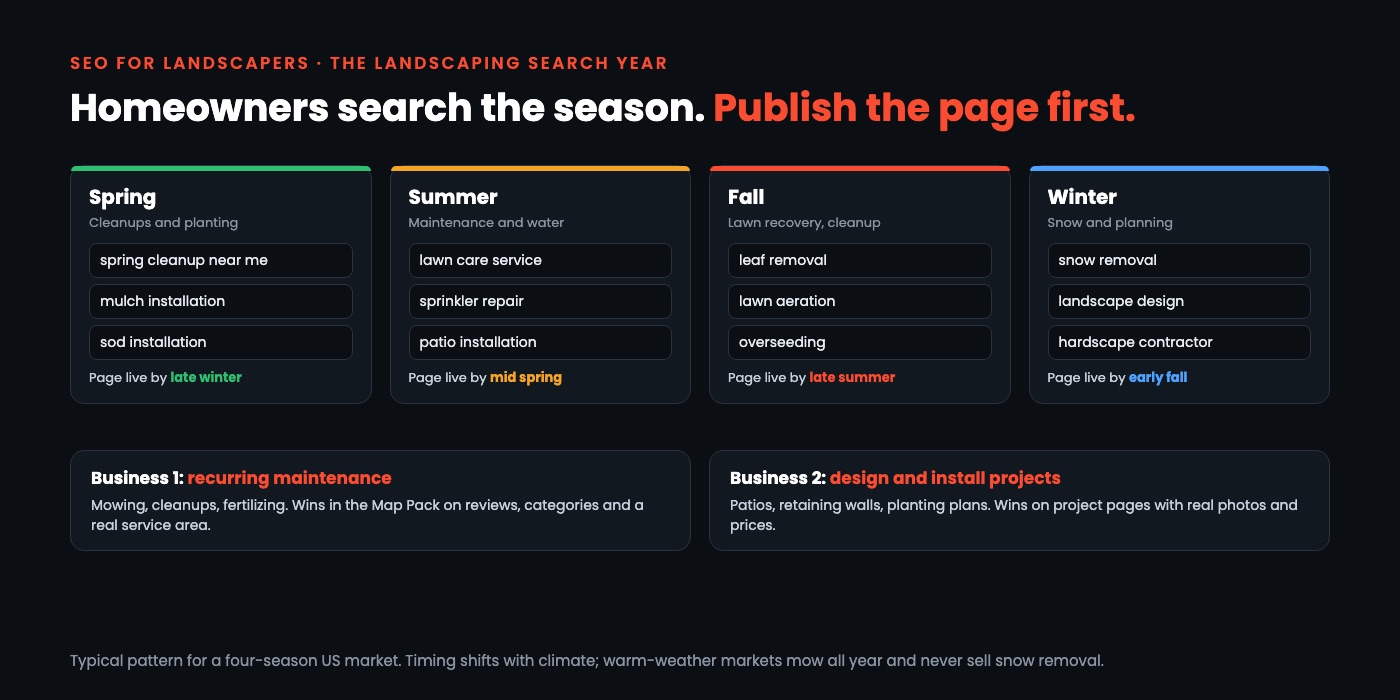
In the second week of March, a homeowner looks out at a yard full of dead leaves, flattened beds and a lawn that came out of winter patchy. They do not search "landscaper". They search "spring cleanup near me", or "mulch delivery and installation", or "sod installation cost". Whoever shows up in the Map Pack for that search gets the call, and very often gets the whole season of mowing that follows.
That is the core of SEO for landscapers. Homeowners search the season and the service, not the company. A landscaping website that has one "Services" page and a gallery is invisible for almost all of those searches, no matter how good the work is.
I should say plainly where I stand: my published case studies are with electricians and other home service trades, not with a landscaping company. What follows is the same local SEO method I use across home services, adapted to how landscaping actually sells. Here is the plan I would follow for a landscaping company in 2026.
Landscaping SEO is two businesses, not one
Most landscaping companies run two different businesses under one name, and they win on Google in different ways.
- Recurring maintenance: mowing, seasonal cleanups, fertilizing, leaf removal, snow removal. Small tickets, repeat customers, short decisions. These are won in the Map Pack, on reviews, categories and a believable service area.
- Design and install projects: patios, retaining walls, planting plans, sod, irrigation, outdoor lighting. Large tickets, long decisions, several quotes. These are won on project pages with your own photos, honest price ranges and a clear process.
Mixing the two on one page confuses Google and the buyer. Someone who wants a $15,000 patio does not want to read about weekly mowing, and someone who wants their lawn cut on Thursdays does not need a design consultation. Keep them separate on the site, and decide which one you want more of, because that decides your primary category and your first pages.
Google Business Profile for landscaping companies
For maintenance work, the Google Business Profile does more than the website. Google says local results are based mainly on relevance, distance and prominence, and prominence includes how many reviews you have and how many websites link to you. The profile is where all three are set.
- Primary category: the one that matches the work you most want. Usually Landscaper; Landscape designer if design and install is the main business; Lawn care service if you mainly mow and maintain. Check the exact names in your profile editor, because Google adds and renames categories.
- Secondary categories: only for services you actually sell, such as snow removal, irrigation or hardscaping. Every extra category you cannot back up with a page and reviews dilutes the profile.
- Service area: most landscapers have no storefront customers visit, so they are service-area businesses. Google allows up to 20 service areas and says the overall area should not stretch beyond about two hours of driving from your base. List the towns you really serve, not the whole state.
- Business name: your real name, exactly as it appears on your trucks and invoices. Google's profile guidelines do not allow adding keywords or towns to the name, and "Smith Landscaping | Lawn Care Snow Removal Austin" is the kind of edit that gets a profile suspended.
- Services and photos: add every service with a short description, and upload new job photos every month during the season. A landscaping profile with three stock images and nothing since 2023 looks closed.
The full field-by-field version is in my Google Business Profile optimization checklist.
Seasonal service pages, published before the season
This is the part most landscaping companies get wrong, and the hero diagram above is the whole idea. Search demand follows the weather: cleanups and mulch in spring, lawn care and irrigation in summer, leaves, aeration and overseeding in fall, snow removal and design planning in winter. A page needs time to be crawled and to start ranking, so a spring cleanup page published in March is already late for that spring.
The rule I use: publish or refresh each seasonal page one season ahead. Spring pages go live in late winter, fall pages in late summer, snow removal pages by early fall. Every year after that, update them with new photos, this year's prices and recent reviews a few weeks before demand starts.
Each service gets its own page. A good one has:
- The service and your main town in the title and H1 ("Spring Cleanup in Round Rock, TX").
- What is included, step by step, in plain words.
- An honest price range or what the price depends on (yard size, debris haul-away, mulch type).
- Photos from your own jobs, with descriptive file names and alt text.
- Two or three reviews that mention that service.
- A clear call button and a short quote form.
HVAC has the same seasonal problem in a different shape; I drew out that calendar in local SEO for HVAC companies, and the timing logic carries over directly.
Is your landscaping site ready for spring?
Send me your website and the towns you serve. I will check your Google Business Profile, which seasonal pages are missing, your reviews and your page speed, and send the three fixes that matter most. Free, within 24 hours.
Get My Free Landscaping SEO AuditProject pages that sell design and install work
For the bigger jobs, the buyer is comparing three or four companies over several weeks, and most of that comparison happens on your website before anyone calls. A gallery of fifty unlabelled photos does not do this job. Project pages do.
One page per notable project: "Paver Patio and Fire Pit, Cedar Park". Before and after photos, what the homeowner wanted, the materials, how long it took, and a price band if the client is comfortable with that. Link each project page to the matching service page (patios, retaining walls, planting design) and back again. Over a year this builds a set of pages that rank for "[service] in [town]" searches, and it gives the buyer exactly the evidence they are looking for. Painting contractors face the same proof problem, and I wrote that version up in SEO for painters.
Two practical notes. Use your own photos, never stock or a supplier's catalog images, because homeowners recognise them and they prove nothing. And compress them: a project page with twelve 6 MB phone photos loads slowly on a phone. Run the page through my free SEO audit tool to see the load time before you publish.
Reviews: recent beats many
Landscaping is a trade where the work is visible from the street, so reviews carry a lot of weight. BrightLocal's Local Consumer Review Survey 2026, a panel of 1,002 US consumers, found that 74% only care about reviews written in the last three months, and 47% will not use a business with fewer than 20 reviews.
For a seasonal business that has a clear meaning: a burst of reviews every spring is not enough, because by August they are old. Build the ask into the routine. Send a review link by text after each cleanup or install, and after the first month of every new maintenance customer. Ask them to mention the service and the town in their own words; that helps relevance without you writing anything for them.
Reply to every review, good and bad. If you are not sure what to say to a one-star review about a missed mowing day, I collected tested wording in Google review response examples.
Local links for landscapers
Links are the part of prominence most landscaping companies never work on, and the ones that do usually pull ahead in the Map Pack. The good news is that landscaping has more natural local link sources than most trades:
- Suppliers and manufacturers: paver and stone brands, nurseries and irrigation manufacturers often run contractor locators or certified installer pages. If you are certified, ask to be listed.
- Trade associations: state landscape associations and the National Association of Landscape Professionals have member directories.
- Local organisations: sponsoring a school garden, a community park cleanup or a local sports field earns a link from a site Google already trusts in your town.
- Garden and home shows: exhibitors are usually listed on the event site.
- Local press: a seasonal tip ("when to aerate your lawn in Central Texas") is the kind of thing a local news site will quote.
Skip paid link packages and "500 directory submissions" offers. They do not move a local business and some do harm.
Landscaping SEO mistakes I see most
- One services page for everything. It ranks for nothing specific.
- Seasonal pages published in season. By the time Google ranks them, the season is over.
- Stock photos. Homeowners can tell, and they are the main thing a landscaping buyer wants to see.
- Keywords stuffed into the business name. A fast route to a suspended profile.
- A service area of the whole state. Google ignores it, and it signals you are not really local anywhere.
- Reviews only in spring. The rest of the year your newest review gets older every week.
- No snow removal page in a snow market. It is the winter cash flow that keeps crews employed, and it is searched every year.
What landscaping SEO costs
For a single-location home service business, honest local SEO retainers usually run $750–$2,500 a month, depending on the size of the market and how much needs building. A landscaping company in a small town with a solid profile sits at the low end; a design and install firm in a large metro that needs a full set of project pages sits higher. The full breakdown, including what you can do yourself, is in how much local SEO costs for home services.
If you want leads this spring while the SEO work builds, ads can fill the gap. Landscaping is one of the few trades where Meta ads do well, because the before and after sells itself; I compared the two channels in Google Ads vs Meta Ads for home services.
Where this fits
Landscaping follows the same local SEO foundations as every trade I work with: the profile, service pages, reviews, local links and a fast site. The overview of how those parts fit together for any trade, and how I work, is on my SEO for contractors page. Pest control is the closest cousin to landscaping, seasonal and searched by the problem rather than the company, and that version is in pest control SEO.
Frequently Asked Questions
Is SEO worth it for landscaping companies?
Yes, for most landscaping companies with a website and a defined service area. Homeowners search for specific services such as spring cleanup, lawn care or patio installation, and the companies in the Map Pack and top organic results get those calls without paying per click. It is worth less for a crew already fully booked by referrals, and worth most for a company that wants more recurring maintenance or larger design and install projects.
How do landscapers get more clients from Google?
Four things do most of the work. A complete Google Business Profile with the right primary category and a realistic service area. A separate page for each service you want to sell, live before its season. Project pages with your own photos. And a steady flow of recent Google reviews, because BrightLocal's 2026 survey found 74% of consumers only care about reviews from the last three months.
What Google Business Profile category should a landscaper use?
Pick the primary category that matches the work you most want: usually Landscaper, or Landscape designer if design and install is the main business, or Lawn care service if you mainly mow and maintain. Add secondary categories only for services you really offer, such as Snow removal service or Lawn sprinkler system contractor. Check the exact names in your profile editor, because Google adds and renames categories.
How long does SEO take for a landscaping company?
In a typical town, a landscaping company that fixes its Google Business Profile, publishes proper service pages and collects reviews every week usually sees Map Pack movement within three to six months. Competitive metro markets take longer. Because the work is seasonal, start in the off season: a spring cleanup page published in March is too late for that spring.
How much does SEO cost for landscapers?
For a single-location home service business, honest local SEO retainers usually run $750 to $2,500 a month, depending on how competitive your city is and how much needs building. A small-town maintenance company sits at the low end; a design and install firm in a large metro sits higher. Packages under a few hundred dollars a month usually mean automated directory submissions and little else.
Should a landscaping company have a separate page for each service?
Yes. A homeowner searching for sod installation wants a page about sod installation, with what it costs, how it works and photos of your jobs. One services page listing twenty things rarely ranks for any of them. Build pages for the services that earn the most, and keep maintenance services and design and install projects on separate pages because they attract different buyers.
Want this plan applied to your landscaping company?
Tell me your town, the services you want more of, and whether maintenance or design and install matters most. You will get your profile, pages and reviews checked against this plan, with the fixes in priority order, before the next season starts.
Get My Free Audit
Local SEO & Paid Ads specialist for home service businesses in the US, UK and Canada. Google-certified, and behind results like 359K organic clicks for a UK retailer and a Texas electrical company's organic traffic doubling in six months.