 Hossainul Sazzad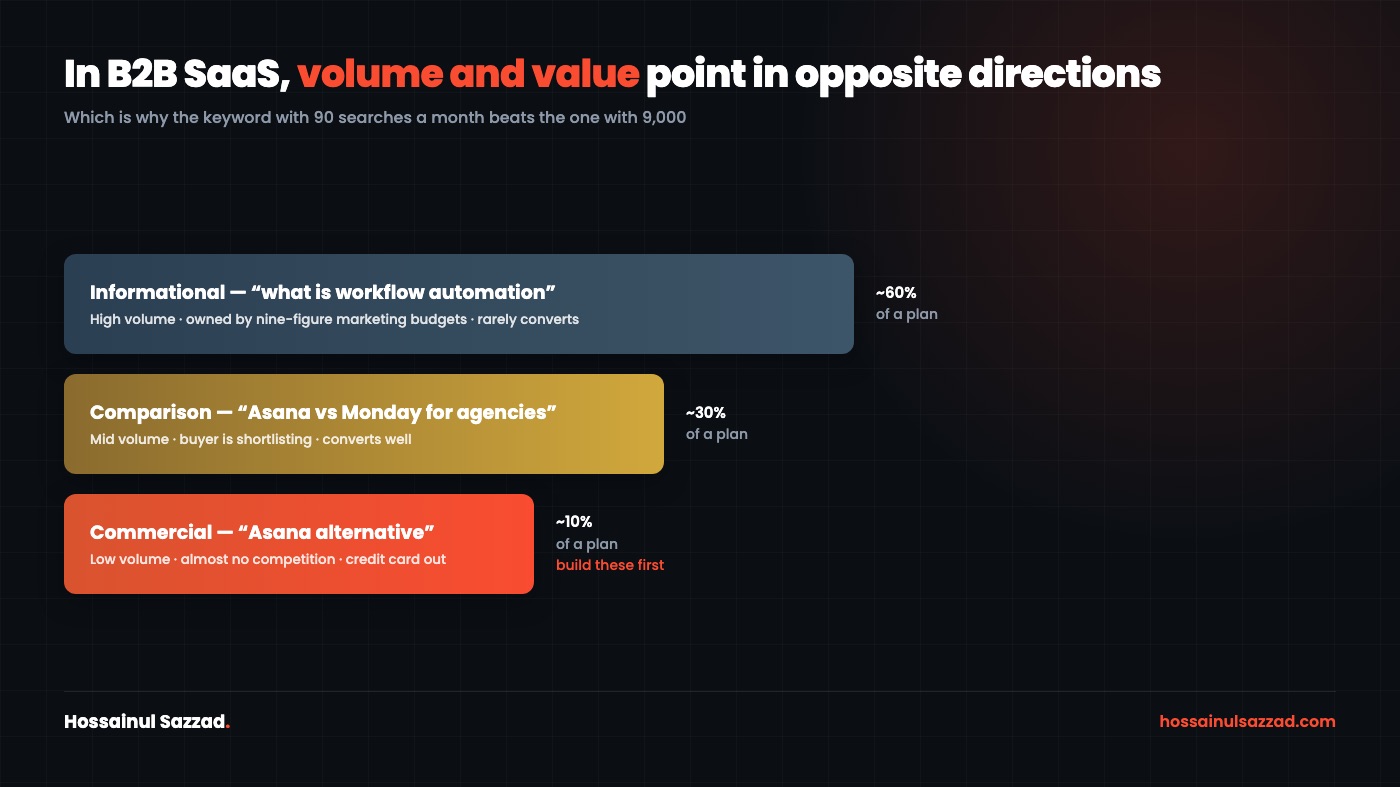
I spent a week last month reading the organic strategy of eleven B2B SaaS companies, what they rank for, what they publish, and where their signups actually come from. Nine of them had the same problem.
They were winning traffic they couldn't convert, and ignoring searches that would have converted immediately.
The pattern was consistent enough to write down. This is what actually works in B2B SaaS organic search in 2026, in the order I'd do it.
Why SaaS SEO breaks the usual rules
Three things make B2B SaaS different from every other SEO context:
- Volume and value are inversely correlated. "CRM software" is enormous and owned by companies with nine-figure valuations. "HubSpot alternative for nonprofits" is tiny and belongs to whoever bothers to write it. The small one closes.
- You're selling to a committee, over months. A single visitor doesn't decide. Content gets forwarded to a technical reviewer, a security lead and someone in finance, and it has to survive all three readings.
- Most demand hides in modifiers. Comparison, alternative, integration, pricing and use-case searches are where buyers sit when they're close. Generic strategies chase the head term and skip all of it.
The practical consequence: a page with 90 monthly searches can outperform one with 9,000. Stop ranking keywords by volume.
1. Fix the technical layer before writing anything
SaaS sites break in specific, repeatable ways:
- JavaScript rendering. If your marketing site is a single-page app, check what Google actually indexes rather than what the browser shows you. Server-side rendering or static generation for marketing pages, always.
- App and marketing site collisions. Logged-in application routes leaking into the index, or the marketing site living on a subdomain that inherits none of the root domain's authority.
- Documentation eating your rankings. Docs subdomains often outrank the marketing pages meant to convert. That's fine when intentional and a problem when it isn't.
- Internal linking. Most SaaS sites are a flat pile of blog posts with no topical structure. Clusters with real internal links move rankings without a single new page.
None of this is glamorous and all of it gates everything else.
2. Map keywords to the funnel, then weight by your sales cycle
A workable starting split is 60% informational, 30% comparison, 10% commercial: but treat that as a default to argue with, not a rule. A product-led tool with self-serve signup should skew far more commercial. An enterprise product with a six-month cycle needs the educational layer.
Within each tier, sort by intent rather than volume. In B2B SaaS, zero-volume keywords are often the fastest path to ranking precisely because every competitor's keyword tool told them to ignore it.
3. Build bottom-of-funnel pages first
This is the single highest-leverage reordering most SaaS teams can make. Before the blog, build:
- "[Competitor] alternative" pages. Someone searching this has already decided to switch. Be honest about where the competitor is genuinely better, buyers can tell, and the page converts far better for it.
- "X vs Y" comparison pages. Including comparisons that don't involve you, which sounds odd until you notice how much traffic and trust they earn.
- Integration pages. One page per integration you support. "Slack integration for [category]" is a real search with real buying intent, and it's usually uncontested.
- Use-case and industry pages. "[Product category] for law firms" beats a generic homepage for every visitor who is a law firm.
- A pricing page that actually answers the question. Hiding pricing behind a demo form loses the searches where the buyer is comparing costs, and those buyers just use a competitor's number instead.
Want to know which bottom-of-funnel pages you're missing?
Send me your domain and your two main competitors. I'll come back with the comparison, alternative and integration pages they rank for that you haven't built, plus your technical blockers. Free, no call needed.
Get My Free SaaS SEO Audit4. Use programmatic SEO only where you have real data
Programmatic SEO generates many pages from a structured dataset, integrations, templates, industries, comparison permutations. It works brilliantly when each page carries genuinely distinct information, and it fails badly when pages are near-duplicates with a variable swapped.
Google's handling of thin generated pages has tightened considerably, and the failure mode isn't "these pages don't rank". It's site-wide quality signals dragging down pages that were fine. Ask one question before building: would this page be useful if a human had written it deliberately? If no, don't generate a thousand of them.
5. Write for the committee, not the keyword
The content that actually moves B2B SaaS pipeline has specifics in it: real numbers, real screenshots, actual implementation detail, named limitations. A 1,500-word definition of a category impresses nobody who is about to spend $40,000 a year.
A practical test, could a champion inside the buying company forward this page to their CTO without embarrassment? Most SaaS blog content fails that test badly.
6. Treat AI assistants as a distinct acquisition channel
Buyers now ask ChatGPT, Gemini, Claude and Perplexity for shortlists ("best help desk for a 20-person team", "alternatives to Zendesk for startups") and act on the two or three products named. Those recommendations are assembled from review platforms, documentation, structured data and community discussion, not from your Google position.
Which means your product can rank third for its main keyword and be entirely absent from the shortlist an AI hands a buyer. I've written up the mechanics in how SaaS companies get cited by ChatGPT and Gemini, and it's the least contested channel in B2B software right now.
7. Report on pipeline, or the programme dies
SEO budgets get cut when the reporting is sessions and rankings, because neither survives contact with a CFO. Track signups and demo requests by landing page, assisted conversions, and pipeline influenced. Then the conversation about next quarter's budget is a different conversation.
What I'd do in the first quarter
- Technical audit and fixes. Weeks 1–4.
- Optimize existing pages already sitting on page two, fastest wins available. Weeks 2–5.
- Build comparison, alternative and integration pages. Weeks 4–10.
- Start the content engine against a mapped plan. Week 8 onward.
- AI search visibility baseline and work. Week 6 onward.
Notice that new blog content is fifth. That ordering is the whole argument of this article, and it's the one most SaaS teams get backwards.
If you want this run rather than read, that's what my SaaS SEO service is.
Frequently Asked Questions
How long does SaaS SEO take to work?
Technical fixes and optimization of pages already ranking on page two can move things in 4 to 8 weeks. New content targeting competitive commercial terms typically takes 6 to 12 months in B2B SaaS. Bottom-of-funnel pages like comparisons and alternatives rank fastest, which is the main argument for building them before blog content.
How much should a SaaS company spend on SEO?
In 2026, B2B SaaS SEO retainers commonly run $3,000 to $8,000 a month for early and growth-stage companies and $15,000 to $40,000 for established players with large content teams. The right number depends far more on how competitive your category is than on your company size.
What are the best keywords for a SaaS company?
The ones with low volume and high intent: competitor alternative searches, X versus Y comparisons, integration searches, and use-case terms qualified by industry or company size. A keyword with 90 monthly searches from buyers ready to switch is worth more than one with 9,000 from students researching a category.
Does programmatic SEO still work for SaaS in 2026?
Yes, when each generated page carries genuinely distinct data, a real integration, a real template, a real use case. It fails when pages are near-duplicates with one variable swapped, and the damage is not limited to those pages: thin generated content drags site-wide quality signals down with it.
Should SaaS companies publish pricing on their website?
Usually yes. Hiding pricing behind a demo form forfeits every search where a buyer is comparing costs, and those buyers simply use a competitor's published number instead. If your pricing genuinely varies by deal, publish a starting point and the variables that move it.
Is SEO or paid acquisition better for B2B SaaS?
They do different jobs and compound together. Paid gives predictable volume and fast feedback on messaging. Organic lowers blended customer acquisition cost over time and keeps producing when spend pauses. Most SaaS companies that come to SEO seriously are already running paid and watching CAC climb.

SEO & Paid Ads specialist working with B2B SaaS and home service businesses in the US, UK and Canada. Google-certified, and behind results including 359K organic clicks in 12 months for a UK client and a Texas company's organic traffic doubling in six months.