 Hossainul Sazzad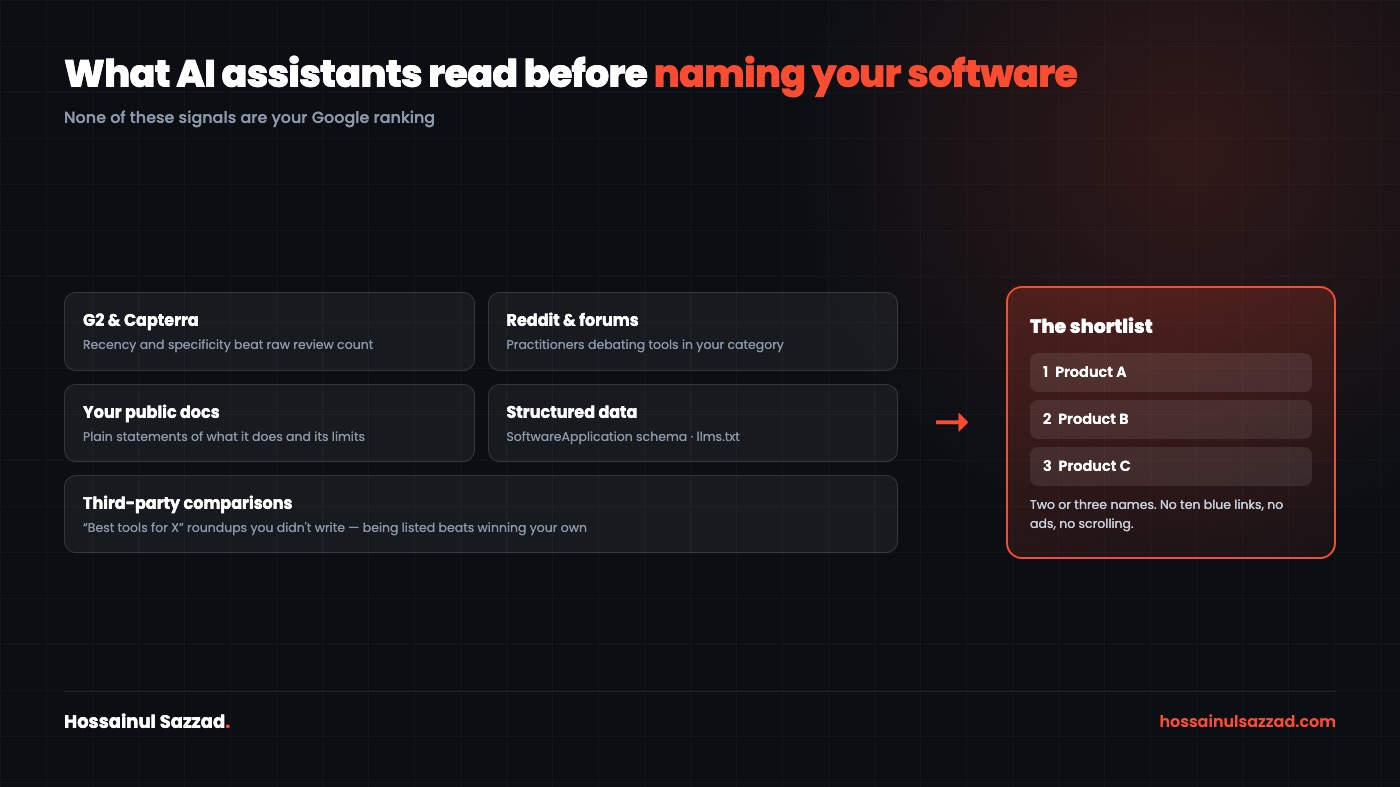
Ask ChatGPT for "the best help desk software for a 20-person startup" and you get three product names, a sentence on each, and a recommendation. No ten blue links. No ads. No scrolling.
For the products named, that's the highest-quality traffic on the internet. Someone arriving pre-qualified and pre-sold. For everyone else it's a channel they can't see, can't measure, and are losing without knowing.
I've been testing what makes an AI assistant name one product over another, and the signals are meaningfully different from what makes Google rank you.
Why your Google ranking doesn't carry over
Google ranks pages. An AI assistant builds an opinion about an entity, your product, from whatever it can verify across many sources, then names the option it's most confident about.
Confidence is the operative word. A model asked for a recommendation is optimizing for not being wrong. It names the product that appears consistently, positively and specifically across the sources it trusts. A product with brilliant SEO and thin third-party presence looks risky to name.
This is why plenty of category leaders on Google are invisible in AI answers, and why smaller products with strong review profiles and good documentation get named repeatedly.
Where AI assistants actually get software recommendations
- Review platforms. G2, Capterra, TrustRadius and Software Advice are heavily represented in software recommendations. Volume matters less than recency and the specificity of what reviewers wrote, reviews that name use cases and company sizes give a model something to match a query against.
- Community discussion. Reddit especially. A thread where real practitioners debate tools in your category is exactly the kind of source these systems weight. You cannot fake this, and attempts to are increasingly obvious.
- Your documentation. Underrated and largely uncontested. Clear public docs that state what the product does, what it integrates with and what its limits are give a model unambiguous, quotable facts. Products with docs behind a login are much harder to recommend confidently.
- Structured data and entity clarity. SoftwareApplication and Organization schema, consistent naming, an
llms.txtfile. This is how you make the machine-readable version of your product agree with the human-readable one. - Comparison content, including other people's. Third-party "X vs Y" articles are a primary source for shortlist questions. Being present in the comparisons written about your category matters more than winning them.
The seven-question audit
Open ChatGPT, Gemini, Claude and Perplexity and ask each the questions your buyers ask:
- "What's the best [your category] for [your ideal customer]?"
- "[Main competitor] alternatives"
- "What does [your product] do?"
- "[Your product] vs [competitor]"
- "Is [your product] good for [specific use case]?"
- "How much does [your product] cost?"
- "What are the downsides of [your product]?"
Record whether you appear, what's said, and what's wrong. Almost everyone running this for the first time finds at least one confidently stated factual error about their own product, outdated pricing, a feature that shipped a year ago described as missing, an integration listed that was deprecated.
That last category is the real finding. You're not just absent; sometimes you're misrepresented, at scale, to buyers.
Want this audit run for your product?
I'll run all seven questions across ChatGPT, Gemini, Claude and Perplexity, document what each says about you and your competitors, and send back the specific fixes that change the answer. Free.
Get My Free AI Visibility AuditWhat actually changes the answer
- Fix the factual record first. Update your G2 and Capterra listings, your own pricing and feature pages, and anywhere else a stale number is being read as current. Correcting misinformation is faster and higher-return than trying to appear where you don't.
- Make your documentation public and specific. State what the product does, its integrations, its limits and who it's for, in plain declarative sentences. Models quote pages that commit to answers.
- Build review recency, not just review count. A steady trickle of recent, specific reviews beats a large pile from two years ago. Ask customers to mention their industry and team size. That's what makes a review matchable to a query.
- Earn genuine community presence. Answer questions in your category on Reddit and relevant forums as yourself, disclosed. Slow, unglamorous, and the strongest signal on this list.
- Add the structured layer. SoftwareApplication and Organization schema, FAQ markup, and an
llms.txtsummarizing what you are. An afternoon of work. I publish one for this site. - Get into third-party comparisons. Reach out to the people writing "best [category] tools" roundups. Being listed at all beats being ranked first in one you wrote yourself.
How to measure it
There's no Search Console for this yet, so measurement is manual and worth doing anyway: run the seven questions monthly across all four engines and log whether you appear and in what position within the answer. Meanwhile, watch your analytics for referrals from chatgpt.com, perplexity.ai and gemini.google.com. Those numbers are usually small and convert far better than organic search, which tells you where this is heading.
The engine-specific mechanics differ, and I keep separate playbooks for ChatGPT, Gemini, Claude and Perplexity, plus the broader generative engine optimization method.
Why this window is open right now
Almost no B2B SaaS company has anyone accountable for AI search visibility. There's no dashboard demanding attention, so it doesn't get any. That's precisely the situation local businesses were in with Google Business Profile a decade ago, and the companies that moved early on that owned their categories for years.
The work isn't exotic. Accurate listings, public documentation, recent specific reviews, real community presence, clean structured data. Deeply unglamorous, and currently uncontested.
If you want the full organic picture rather than just this slice, start with my SaaS SEO playbook or the SaaS SEO service page.
Frequently Asked Questions
How do AI assistants decide which software to recommend?
They build a picture of your product from sources they can verify, review platforms like G2 and Capterra, community discussion on sites like Reddit, your public documentation, structured data, and third-party comparison content. Then they name the option they are most confident about. Confidence is the key variable, which is why consistency across sources matters more than any single strong page.
Does ranking well on Google mean AI tools will recommend my product?
No. Google ranks pages while an AI assistant forms an opinion about your product as an entity. Plenty of products that rank first for their category keyword are never named in AI answers, because their third-party presence (reviews, docs, community discussion) is thin. The two channels draw on different signals.
How do I check what AI says about my SaaS product?
Ask ChatGPT, Gemini, Claude and Perplexity the questions your buyers ask: best tool for your category and customer type, your main competitor's alternatives, what your product does, comparisons against rivals, suitability for specific use cases, pricing, and downsides. Log what each says. Most teams find at least one confidently stated factual error about their own product.
What is llms.txt and does my SaaS need one?
It is a plain text file at your domain root that gives AI models a clean summary of what your company is, what it does and which pages matter. It takes about twenty minutes to write and it removes ambiguity for any model reading your site. Low effort, no downside, and still rare enough to be a small edge.
Do G2 and Capterra reviews affect AI recommendations?
Substantially, for software specifically. Those platforms are heavily represented in AI answers about tools. What matters is recency and specificity rather than raw count, reviews that name the reviewer's industry, team size and use case give a model something concrete to match against a query.
Is AI search traffic worth pursuing given the volume is small?
The volume is smaller than Google today and the intent is dramatically higher, because the visitor arrives having been recommended rather than having sifted results themselves. It also compounds: the fixes involved (accurate listings, clear documentation, recent reviews, real community presence) improve conversion from every other channel at the same time.

SEO & Paid Ads specialist working with B2B SaaS and home service businesses in the US, UK and Canada. Google-certified, and behind results including 359K organic clicks in 12 months for a UK client and a Texas company's organic traffic doubling in six months.